To read a US sunscreen label, look for broad-spectrum protection, the SPF value, water-resistance information, and the actual directions. Then check whether the bottle is still within its usable date and whether its instructions fit the activity you are planning.
The front of the package helps you narrow the choice, but the back explains how you are meant to use it. You will make a better decision by reading both than by selecting whichever bottle has the largest number or the most reassuring beach imagery.
Read the three front-label details together
SPF describes sunburn protection, primarily against UVB, and it is not a personal timer for how long you can stay outside. Broad spectrum indicates protection against both UVA and UVB; the American Academy of Dermatology recommends choosing SPF 30 or higher. (AAD: How to select a sunscreen)
Water resistant means something different from waterproof, which is not a valid promise for sunscreen. The label states either 40 or 80 minutes of water resistance during swimming or sweating, and you still need to follow its reapplication directions.
Those are separate pieces of information rather than three ways of saying the same thing. You should not assume a high SPF automatically supplies broad-spectrum labeling or water resistance.
Take a moment to find each detail on the actual package you plan to buy. Similar colors and product names within a brand do not prove that every version carries the same claims.
Turn the bottle around before deciding
Find the Drug Facts panel and read the directions and warnings in full. The front-label shorthand is useful only when you pair it with the instructions for that specific product.
Check the intended user, the application directions, any areas to avoid, and the instructions related to swimming or sweating. If the print is difficult to read, look up the manufacturer’s current label or ask a pharmacist to help.
Do not rely on a shopping thumbnail to answer a question about the bottle in your hand. Online listings can contain multiple sizes or versions, and a familiar product name can still refer to a different package.
If you cannot locate clear directions for the exact product, choose a better-documented option rather than filling in the gaps from memory. Sunscreen is not a place where an attractive design should replace usable instructions.
Treat water resistance as an activity detail
Before a pool visit, outdoor workout, or long walk, read the water-resistance statement and the reapplication instructions together. Choose a product suited to the activity instead of assuming an everyday facial formula has the same directions as a sports lotion.
FDA guidance calls for reapplying at least every two hours and more often with swimming or sweating. Your bottle’s water-resistance and towel-drying directions matter too, so do not treat the general interval as permission to ignore them. (FDA: Sunscreen—How to Help Protect Your Skin from the Sun)
Imagine finishing a swim and drying off before lunch. The useful question is what your label says to do then, not whether the SPF number sounded high enough when you left home.
You can prepare for that moment by keeping the product and a way to read its directions accessible. A bottle buried at the bottom of a bag is less useful when you need to reapply and are already moving to the next activity.

Read a fictional package as practice
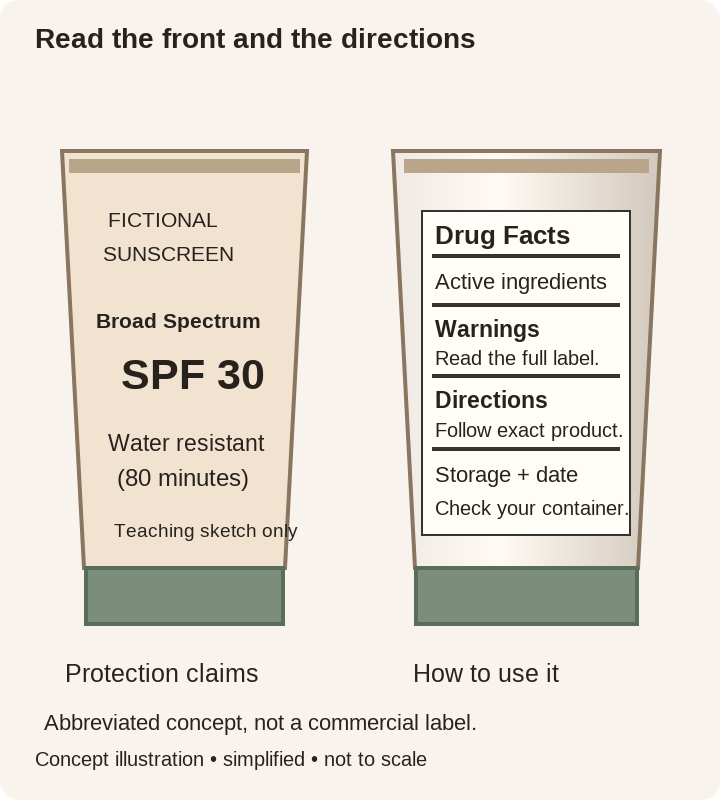
In the illustration, the front identifies a broad-spectrum SPF 30 product and a water-resistance claim. The back is shown as a separate panel to remind you that the complete directions remain essential.
This is a teaching sketch, not a compliant commercial label or a recommendation of an actual sunscreen. You should read your real package rather than copying the sketch’s abbreviated wording.
Now ask where you would find the information if the package were a stick, a spray, or a small travel tube. The layout may change, but you still need clear identification and instructions for the exact item.
You can also practice distinguishing a claim from a feeling word. Descriptions such as light, silky, or beach-ready do not replace SPF, broad-spectrum, water-resistance, or Drug Facts information.
Check the date and the storage history
FDA advises discarding expired sunscreen and treating a bottle without an expiration date as expired three years after purchase. It also advises protecting the container from excessive heat and direct sunlight.
You can make the date check easier by writing the purchase date on a bottle that lacks an expiration date and keeping a simple record. If the age is unknown, do not use a guess as evidence that the product is still suitable.
Look at where the bottle lives between outings. A consistently organized storage spot makes it easier to find the date and directions than a collection of loose tubes scattered between cars, bags, and bathroom drawers.
Do not decant sunscreen into an unmarked container just to make a kit look tidier. Keeping the original label and closure preserves information you may need when choosing, using, or replacing it.
Build a plan that includes clothing and shade
Sunscreen belongs alongside other sun-protective measures, including shade and suitable clothing. A label cannot tell you that it is fine to ignore the conditions around you or remain exposed indefinitely.
Before an outdoor event, think about where you will sit, what coverage your clothing provides, and where the sunscreen will be accessible. Planning the setting is as practical as remembering the bottle.
For example, a ballgame may involve a long walk from parking, time in uncovered seats, and a return trip later. You can prepare for those parts of the outing rather than thinking only about the moment you arrive.
A cap, sunglasses, and a shaded rest spot each solve different practical problems. You do not need to turn them into a complicated system, but you should not ask one bottle to take the place of every other measure.
Compare versions carefully when shopping
If you are choosing between two products, write the exact version beside the key label details. Include the size and whether the directions match the activity you expect to do.
Do not assume the tinted and untinted versions, or the lotion and spray versions, are interchangeable just because they share a brand name. Read each package instead of transferring information between similar products.
Check whether you can open the closure, dispense the product, and manage its texture in the place where you will use it. These usability questions matter because a suitable label cannot help if the product is too inconvenient for your routine.
If you have a history of reactions, ask a qualified professional about the specific options rather than relying on a broad marketing word. Keep the ingredient list available so the conversation can be about the real formula.
Avoid the easy shortcuts
A moisturizer or makeup product with sunscreen labeling still needs to be used according to its sunscreen directions. The presence of SPF on the front does not let you ignore amount, timing, or reapplication information.
Do not mix sunscreen with another product in your palm to make a preferred texture. Choose a product you can use as labeled rather than changing the formula yourself.
You also should not infer protection from the color or fragrance of a cosmetic that has no sunscreen claim. A comfortable body oil or lip gloss is not sunscreen just because you use it outside.
If you are shopping for a child or have a specific medical question, read the age-related directions and get appropriate advice. This general label guide cannot replace individualized instructions from your clinician.
Finish with a usable choice
Before leaving the aisle, confirm that you can identify the protection claims, follow the directions, check the date, and fit the product into your planned outing. If an important detail remains unclear, resolve it with the manufacturer or pharmacist before relying on the product.
You do not need to memorize every term on every label. You need to recognize which details answer different questions and keep the exact instructions close enough to use when they matter.
Photo Credits
- Check the label before your outing and keep the directions accessible. Stock photograph by Mikhail Nilov; illustrative context.