Your skin tone can influence what a sunscreen looks like on you, but it does not give you a reason to leave sun protection out of your day. Start with protection you can use as directed, then make its texture, tint, and place in your routine work for you.
You do not need to choose between taking sun protection seriously and caring about how your face looks. A product that leaves you feeling gray, greasy, or conspicuously mismatched presents a real shopping problem, and you can address that problem without treating your natural color as immunity.
Begin with the shared foundation
The American Academy of Dermatology recommends sun protection for everyone, including people with brown and Black skin. Its advice for darker skin includes shade, protective clothing, and a tinted, broad-spectrum, water-resistant sunscreen with SPF 30 or higher (AAD guidance).
The AAD also explains that visible sunlight can contribute to dark spots in darker skin and recommends tinted sunscreen containing iron oxide for that concern. A tint’s color match and the protection described on the label are separate things to assess.
Keep those points in perspective when you shop. A flattering finish is helpful, but it does not tell you whether the product offers the label features you need or whether you will follow its directions.
Conversely, an impressive-looking number does not tell you whether a tint suits your face. You can check the protection information first and still reject a formula whose shade or feel would make it hard for you to use consistently.
Separate skin tone from the rest of your preferences
Start a shopping note with the things that bother you about your current product. Write down visible residue, unwanted shine, transfer onto collars, a tint that looks orange, or packaging that makes an adequate application awkward.
Try to describe what you actually observe rather than assigning a sweeping rule to everyone with your skin tone. A finish that your friend calls invisible may look quite different beside your hairline or on the back of your hand.
Your preferred finish may also depend on what you wear that day. You might want a different cosmetic effect beneath makeup than you want during a sweaty afternoon outdoors, while still checking the protection and use directions for either choice.
Keep your comfort preferences alongside any known ingredient restrictions supplied by your clinician. A personal allergy history is more specific information than a social-media claim that a whole filter category is universally right or wrong for your complexion.
Check a tint as a shade, not a promise
Look for clear product photographs, shade descriptions, and the manufacturer’s information about available options. If a brand offers only one shade, do not assume that the word universal guarantees a match for every depth and undertone.
If a suitable sample or return option is available, consider it before buying several bottles. Check the seller’s actual terms rather than assuming that an opened product can always be returned.
When you assess the cosmetic appearance, use the product according to its directions. A thin trace that blends beautifully does not tell you what the finish will look like when you use the amount the product requires.
Look at your jawline, hairline, and the transition toward your neck in ordinary light. This is a visual matching exercise, not a home test of SPF or a way to certify protection from a photograph.
Give yourself permission to reject an unsuitable shade. If your first choice looks wrong, look for another appropriate sunscreen instead of deliberately underapplying that one so its color is less obvious.

Make a practical two-product comparison
Imagine that one suitable sunscreen leaves a finish you like but comes in a small tube, while another has a less appealing finish and a larger package. Compare how each would fit your actual use instead of choosing only from the front label.
Ask whether you can buy it again, carry it comfortably, and identify the directions without searching online every time. A formula you can restock locally may be more practical for you than a difficult-to-find option you feel reluctant to use up.
Check the full product name and shade when reordering. Similar package colors can hide different versions, and a recommendation for one exact formula does not automatically describe every item in the same brand’s range.
If you order online, confirm that the listing shows the actual labeling for the product being sold. If the information is missing or contradictory, ask the seller or manufacturer before treating the listing as a reliable match.
Price deserves a place in this comparison because repeated use means repeated purchase. You can set a realistic budget without interpreting a higher price as proof of better results or a lower price as evidence that a product cannot work.
Think about the areas your outfit leaves exposed
Stand in front of a mirror in the clothes you plan to wear outdoors. Notice where sleeves stop, whether your neckline changes when you move, and what remains uncovered when you sit down or take off a jacket.
This simple outfit check helps you make a concrete plan instead of limiting your attention to your face. It can also reveal why the bottle in your makeup bag and the one you take on a long outing serve different practical roles.
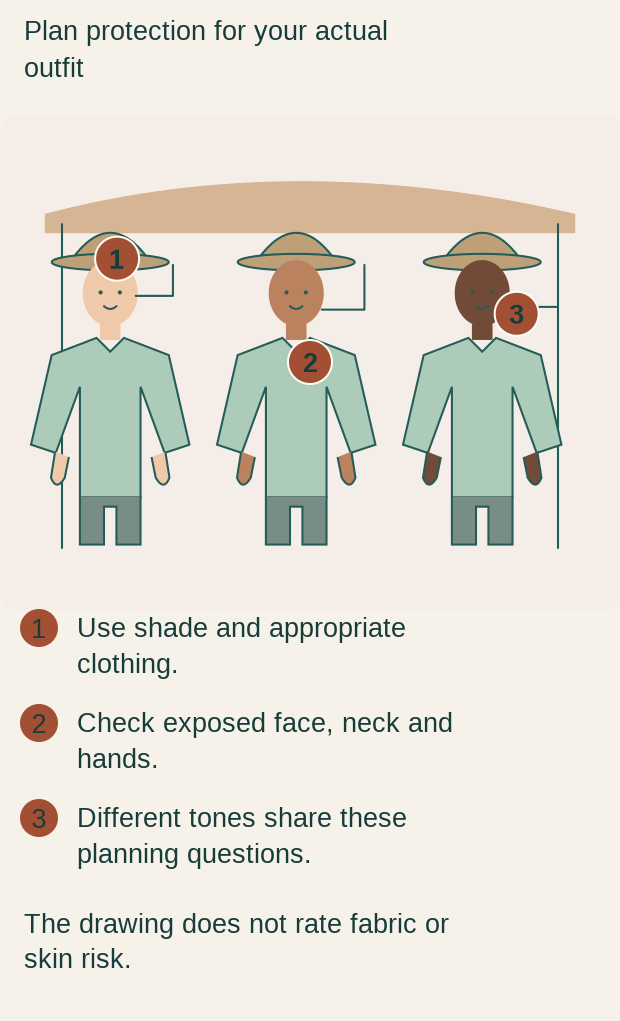
Choose a hat and covering layer you can comfortably carry and use. For a particular garment’s protection rating, read its own labeling; the illustration here does not certify a shirt, hat, or fabric.
You can plan shade in equally ordinary terms, such as a covered lunch table or a route with a sheltered rest stop. Treat those arrangements as useful parts of the outing rather than a reason to ignore the sunscreen’s directions.
Original concept illustration. Three adults with different skin tones wearing hats and long sleeves under shade, with exposed faces and hands. It is not a clinical assessment or a product certification.
Keep changing marks separate from cosmetic shopping
Sun protection is one part of skin care, but it cannot tell you what a new or changing mark means. The AAD notes that skin cancer can occur in darker skin and can appear in areas that get little sun, including palms, soles, and nails (AAD skin-cancer guidance).
If you notice a concerning change or a sore that does not heal, arrange an assessment instead of assuming that a different tinted product will answer the question. Bring your observations to a qualified professional rather than relying on a color match or an online image.
If dark spots are the reason you began shopping, be precise about your goal. You may want help preventing further sun-related darkening, while the cause and treatment of existing discoloration still deserve a separate discussion with a dermatologist.
Avoid building a large treatment routine at the same time you are trying to find a usable sunscreen. Keeping your shopping decisions distinct makes it easier to explain what you changed and what problem you are still trying to solve.
Keep your own experience in a useful record
After using a product, record the exact version, shade, and what you noticed about its finish. You might note that it looked chalky near your eyebrows or transferred onto a particular shirt, without claiming that your observation proves anything about its laboratory protection.
Photographs can help you remember a cosmetic mismatch if you take them in consistent ordinary lighting. They cannot replace the label, measure ultraviolet protection, or establish that the product will look the same on someone else.
When you ask for recommendations, describe the problem you need solved. Saying that you need a less orange tint or a finish that works with your usual makeup gives another person a clearer starting point than simply asking for the best sunscreen for a broad racial category.
You can also explain the practical limits, such as a store you can access or a budget you can sustain. Those details make the next recommendation more relevant without turning a shopping conversation into individualized medical advice.
Build a routine that respects both protection and appearance
Keep the final decision small enough to act on: select an appropriately labeled product, read its directions, and make room for clothing and shade. Then check whether the finish and packaging let you use it in the way those directions require.
If the answer is no, revise the product choice or ask for professional help with a specific concern. You do not need to accept a poor shade match as inevitable, and you do not need to pretend your skin tone removes the need for protection.
A useful routine fits your life without making claims your mirror cannot verify. Let the label guide use, let your own observations guide cosmetic preferences, and let a clinician assess symptoms or changing skin findings that shopping alone cannot explain.
Photo Credits
- A staged stock scene of sun-care preparation; the photograph does not establish application adequacy or product performance. Photo: cottonbro studio, Pexels.