You don’t need a quiz score to describe how your skin behaves. Start with the things you can actually notice during an ordinary day: where you look shiny, where you feel uncomfortable, and which products you already enjoy using.
A useful description helps you shop with fewer guesses, but it doesn’t diagnose a condition. Think of your notes as a working description you can revise, rather than a permanent identity that controls every purchase.
Use the labels as shorthand
Dry, oily, and combination describe different everyday tendencies. Combination skin can have oilier areas alongside drier ones, often involving the forehead, nose, and chin, as the American Academy of Dermatology explains.
You can also find a product uncomfortable without knowing exactly why. Instead of forcing that experience into a quiz category, record what happened in plain language and keep the product name beside it.
For example, “my cheeks feel tight after this wash” is more useful than “my skin is impossible.” The first sentence identifies an area, a feeling, and a situation you can explain to someone else.
Don’t assume that every shiny area needs an aggressive cleanser. The AAD’s oily-skin guidance favors gentle washing and warns against scrubbing, even when you want to remove oil.
Observe an ordinary day
Choose a day that looks reasonably like your usual life, with your usual indoor time, commute, and meals. A day spent hiking in unusual weather can be interesting, but it isn’t a fair stand-in for your regular routine.
Keep your existing routine steady while you notice what happens. You don’t need to deliberately leave your face uncomfortable, skip prescribed care, or follow an internet challenge that asks you to wash and wait without products.
Make a quick note when you’re already near a mirror, perhaps before leaving home and again before your evening routine. Those moments are convenient checkpoints, not a clinically validated observation schedule.
An everyday mirror check is enough for descriptive notes; this stock photograph does not show a skin assessment.

Use ordinary lighting when you can, and keep the comparison conditions similar. If your first look is under a bright bathroom lamp and the next is beside a window, write that difference down rather than treating every visual change as a skin change.
Make a small map of your face
Divide your notes into forehead, nose, cheeks, and chin. You aren’t measuring oil production, and you don’t need to touch your face repeatedly to prove what you see.
Write one short observation for each area, using words you would use in conversation. “Nose looks shiny by lunch; cheeks feel comfortable” gives you a clearer picture than awarding your whole face an oiliness score.
If one cheek behaves differently from the other, keep that detail instead of averaging it away. Note anything obvious about the situation, such as where a mask, scarf, or another item was touching, without declaring that item the cause.
A note-taking map, not a diagnostic chart: describe each area separately.
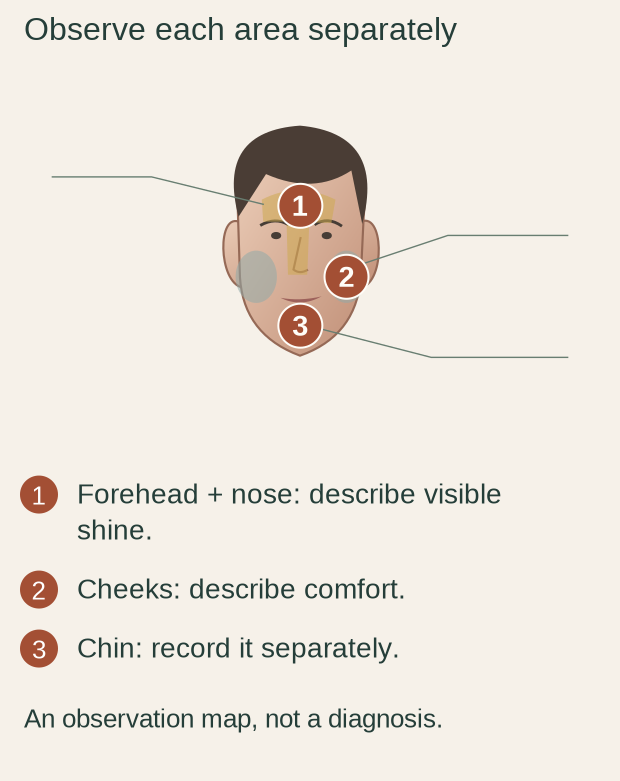
You can draw the same map on paper with a few circles and labels. Keep it simple enough that you will actually use it, rather than turning a shopping question into a daily project.
Separate what you see from what you feel
Your mirror and your comfort are two different kinds of information. Record visible shine separately from tightness, itching, tenderness, or another sensation instead of assuming one automatically explains the other.
Try a sentence with two parts: “My forehead looks shiny, and my cheeks feel tight after washing.” You don’t have to choose which half counts as your true skin type.
Keep persistent or troubling symptoms out of the shopping-label bucket. A recurring rash or significant discomfort deserves professional assessment, rather than another round of guesses about whether you’re oily or dry.
Add the routine context
Beside each note, list the cleanser, moisturizer, sunscreen, and makeup you used that day. Use exact product names when possible, because a brand can sell several similarly named formulas.
You can keep a photograph of the packaging in your phone rather than copying a long ingredient list. A picture of the front and back also helps you remember whether you’re describing the same version next month.
Then add one line about anything unusual, such as travel, a new product, or a different washing routine. These details provide context; they don’t establish that you have found a trigger.
Suppose your face feels different during a hotel stay and returns to its usual pattern at home. Your honest conclusion is that the circumstances changed together, not that you have proved the hotel water changed your skin type.
Look for patterns without chasing certainty
After several ordinary days, reread the notes once rather than inspecting yourself more closely every hour. You are looking for repeated practical problems, such as an uncomfortable cleanser or a moisturizer you dislike wearing.
If the notes don’t form a clear pattern, you can leave the label undecided. “Comfortable most days, with occasional dry-feeling cheeks” can still guide a sensible conversation at a store or appointment.
A viral quiz may give you a crisp answer because it has to return one of its preset categories. Your own description can stay messier and more specific, which is often more useful when you actually compare products.
Turn the notes into a shopping brief
Write down the problem you want a purchase to solve before you browse. “I want a moisturizer I can comfortably wear under sunscreen” gives you a clearer task than “I need everything for combination skin.”
Include a texture preference, a budget, and a packaging preference if those matter to you. These are personal shopping criteria, not medical judgments about which formula your skin must receive.
You might prefer a pump because you share a crowded sink, or a small tube because you move between home and work. Those details affect whether a product fits your life even when two labels mention the same skin type.
Don’t buy a whole new line just because its category matches your notes. Compare one needed item first, read its directions, and keep enough information to identify it if you later need help.
Change one question at a time
If your main concern is how your cleanser leaves your face feeling, make that your first question. Buying a cleanser, toner, serum, and moisturizer together gives you four new experiences to untangle.
You can also decide that nothing needs buying yet. If your routine is comfortable and you mainly wanted a label, a few descriptive notes may answer the useful part of the question without adding anything to your shelf.
When you do introduce something new, follow the product instructions and read our separate guide to cautious home use testing. A skin-type label doesn’t promise that a particular product will agree with you.
Try a realistic note before buying
Imagine your notes show shine on your nose after lunch but no discomfort there, while your cheeks feel uncomfortable after your current cleanser. That description gives you a specific starting question about washing rather than a reason to buy separate treatments for every facial zone.
You can tell a store associate exactly what you want to compare and decline extras that don’t address that question. If the answer becomes medical, take the same notes to a clinician instead of asking the associate to diagnose the pattern.
Set a spending limit before the conversation so a long product demonstration doesn’t quietly become a shopping list. Your notes should help you make a decision you understand, including the decision to wait.
Know when your notes are for a clinician
If symptoms keep returning, interfere with your day, or make you unsure what care is appropriate, bring your notes to a qualified clinician. You don’t need a confident diagnosis before asking for help.
Take the exact product names, approximate start dates, and any useful photographs with you. Explain what you observed and what you changed, while leaving the cause open for assessment.
Your most useful outcome isn’t a perfect category. It’s a routine description that helps you make fewer guesses, recognize a real problem, and choose the next practical step with clearer information.