You do not need a shelf full of little bottles to begin taking care of your skin. You need a few understandable steps, products you can comfortably use, and a place for those steps in your actual day.
The American Academy of Dermatology describes a simple starting approach: cleanse, moisturize, and protect your skin from the sun. Think of that as your foundation, with extra products waiting until you have a clear reason to add them. (AAD: Skin care on a budget)
This guide helps you organize that foundation without turning your bathroom into a laboratory. It offers general education, so a prescribed routine or advice from your clinician takes priority when you have a skin condition.
Start with your day, not a shopping list
Before you buy anything, look at what you already use and when you realistically have a few minutes. Your easiest routine might happen after brushing your teeth, rather than at the exact time someone on social media recommends.
Put your current cleanser, moisturizer, and sunscreen on the counter, then read their names and directions. Set aside optional products for a moment so you can see whether the basics are already covered.
Imagine an ordinary Tuesday: you wake up late, leave for work, wash after a sweaty walk, and get ready for bed. A useful routine has to fit those moments, including the evenings when you would rather do almost anything else.
Choose a modest goal you can observe, such as finishing your routine without feeling confused. That gives you something more useful to work toward than a promise of perfect skin by next weekend.
You can make a short note of what feels comfortable and what seems troublesome. Keep it descriptive, because an observation such as tightness after washing tells you more than deciding you have a damaged barrier from a single video.

Step one: cleanse gently
A cleanser is the wash-off part of your routine, so begin by following the directions on its package. The AAD recommends lukewarm water, gentle fingertips, and avoiding scrubbing, which gives you a straightforward technique to practice. (AAD: Face washing 101)
Start with clean hands and wet your face if the product directs you to. Work gently around the areas you need to wash, rinse thoroughly, and pat rather than rub with a soft towel.
Foam is a texture preference, not a score for how hard a cleanser works. A milky product and a lathering wash can both belong on a basic shelf, but neither description guarantees how your individual skin will feel.
Do not measure success by trying to make your face feel squeaky. If washing consistently leaves you uncomfortable, note the product and technique rather than adding another product to compensate without understanding the problem.
The AAD advises limiting face washing to twice daily and after sweating. Fit your washing around that guidance and your clinician’s instructions, instead of adding a full cleanse every time you pass a mirror.
Evening is a helpful anchor because it gives your routine a recognizable end point. If makeup or a particular water-resistant product needs its own removal instructions, follow those rather than repeatedly rubbing your skin with the same wash.
You do not have to purchase a cleansing brush to complete this step. Keeping the process simple also makes it easier to notice whether the cleanser itself suits you.
Step two: make moisturizing practical
Your moisturizer is the leave-on part of this foundation, and the texture should be something you are willing to use. A bottle you avoid because you dislike the feel is not a particularly useful purchase for your routine.
The AAD recommends applying moisturizer to damp skin, including when you have oily skin. You can make that easier by keeping the moisturizer within reach of the towel rather than tucked behind several unrelated products.
A lotion, cream, and ointment may feel quite different, so do not assume you need the thickest option everywhere. Read the intended use and choose for the body area and circumstances you are actually dealing with.
For example, the moisturizer you enjoy on your hands at bedtime might be inconvenient under your morning makeup. That is a practical preference to consider, rather than proof that one texture is universally better.
Start with the amount and directions on the label, then avoid turning the step into a vigorous massage. You can spread it gently and move on with your day without waiting for a dramatic sensation.
Keep the rest of your routine steady while you consider a change. If you replace your cleanser, moisturizer, and several optional products together, your notes will have a much harder time explaining what happened.
Step three: plan your sun protection
Sun protection involves more than putting a bottle beside the sink. The AAD recommends shade, protective clothing, and a broad-spectrum, water-resistant sunscreen with SPF 30 or higher for exposed skin. (AAD: Practice Safe Sun)
Read the directions on your own sunscreen, including application, reapplication, and any water-resistance wording. Those details matter more than choosing a bottle simply because it matches the colors of your other products.
The AAD advises reapplying sunscreen every two hours while outdoors, as well as after swimming or sweating. An application before breakfast is therefore not a plan for an entire afternoon at the beach. (AAD: How to apply sunscreen)
Build the practical pieces into your outing: bring your sunscreen, consider a hat and suitable clothing, and think about where you can find shade. Your bathroom routine starts the day, while your sun protection plan continues beyond it.
A moisturizer that includes sunscreen can reduce the number of separate products, but it still needs to be used as sunscreen. Check that its protection and directions suit the plan instead of assuming any mention of SPF covers every situation.
You do not need to treat the finish of one sunscreen as a verdict on all sunscreens. If you dislike a texture or visible cast, use that experience to guide a careful comparison of another suitable formula.
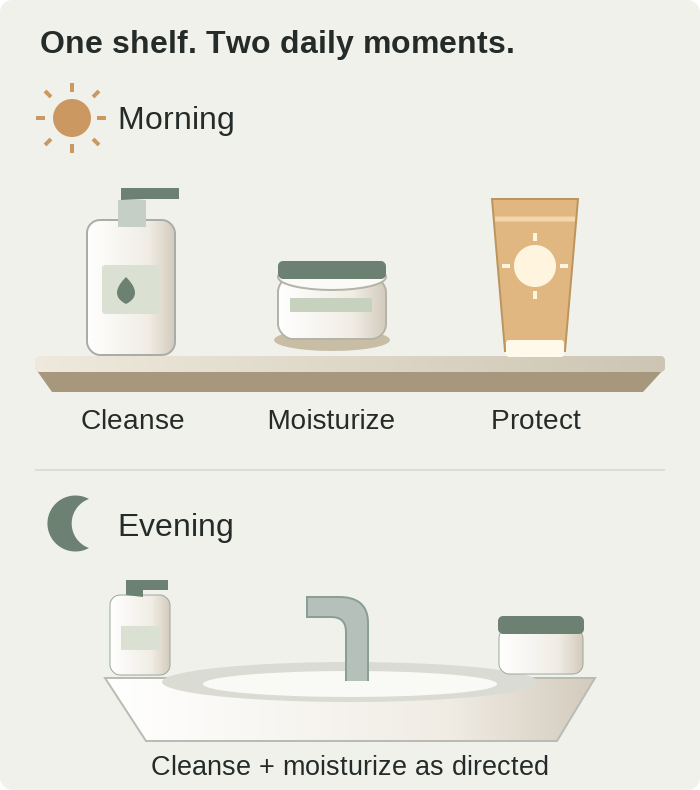
Original concept illustration. The everyday foundation can live in two small moments; use each product as directed.
Give the routine a morning and an evening home
You can organize your morning around cleansing when appropriate, moisturizing, and sun protection. Your evening can focus on the cleansing and moisturizing steps your skin and existing instructions call for.
Think in terms of two small places in your day rather than six appointments with a timer. Your routine should help you get ready and wind down, without making every ordinary activity feel like an interruption.
If you share a bathroom, put the essentials together in a washable tray or a clearly designated section. The goal is to reach the right bottle easily, including when you are tired or someone else has moved things around.
Keep the packaging readable, especially if several bottles look similar. Decanting everything into identical unmarked containers may look tidy, but it removes the directions and identity you need to make informed choices.
A small travel setup can follow the same logic, provided the products are stored appropriately and their information remains available. You can photograph the original labels for your own reference before packing, rather than trusting your memory.
Be curious about labels and cautious about promises
Words such as natural and hypoallergenic can sound more reassuring than they are informative. The FDA explains that cosmetic allergy-related marketing terms do not establish a guarantee that you will avoid a reaction. (FDA: Allergens in Cosmetics)
Read the ingredient information and warnings instead of using a single front-label phrase as your entire decision. If you know you react to an ingredient, that history deserves more attention than a general sensitive-skin claim.
You also do not need every fashionable ingredient to create a complete foundation. Before adding a serum or exfoliant, ask what specific question it answers and whether you understand how its directions fit your current routine.
Give yourself permission to leave an optional step out. A clear routine with a purpose is easier to manage than a collection assembled because each bottle sounded individually convincing.
Know when a simpler shelf is not the answer
A basic routine can help you organize everyday care, but it does not diagnose a rash, persistent acne, or an allergic reaction. If you have symptoms that concern you, a dermatologist can assess them and explain what belongs in your particular plan.
Bring the product names, ingredient labels, and a short timeline to that conversation. It is easier to discuss what changed when you can say which bottle you started using, rather than trying to remember its packaging color.
If a product causes a reaction, stop using it and seek appropriate medical advice instead of assuming discomfort means it is working. Avoid experimenting with several new products while you are trying to understand a problem.
Your next step can be quite small: identify the basics you already own, read their directions, and give each one a place in your day. You can build from there when you have a useful reason, without buying an entirely new routine tonight.
Photo Credits
- A routine has to fit an ordinary moment at the sink. Stock photograph: Miriam Alonso / Pexels; not a product test.