You do not need to arrive at a dermatology appointment with a diagnosis you found online. A clear description of what bothers you, the products you use, and the questions you want answered gives you a more useful starting point.
Preparation is especially helpful when the appointment is about a routine that has become confusing. You may remember every bottle perfectly at home, then draw a blank when someone asks what you put on your face last Thursday.
Think of the following as a way to organize your information, rather than a script for a medical assessment. Your dermatologist decides which details matter and whether your concerns require examination, testing, or treatment.
Start with the question you actually want answered
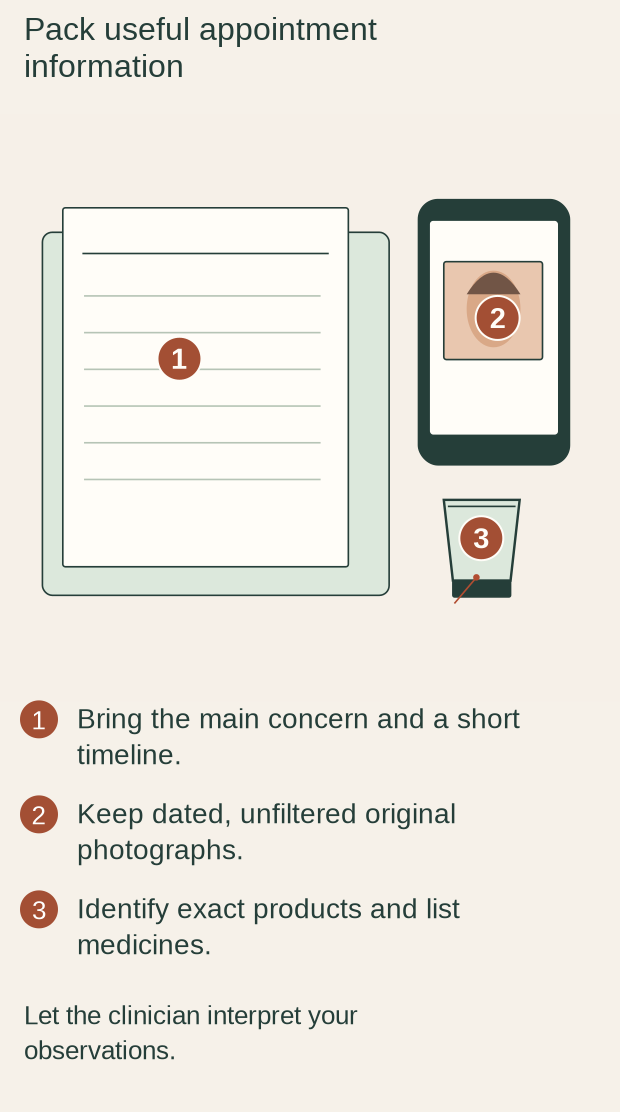
Write your main concern in a single everyday sentence before you build a long product inventory. You might want to understand repeated stinging, ask whether a current routine fits a prescribed treatment, or discuss dryness that keeps returning.
Then add what you hope the appointment will help you do. A practical goal such as knowing which products to continue gives the conversation a clearer destination than asking for a completely new shelf without explaining the problem.
The National Institutes of Health recommends listing your concerns and putting the most important ones first. If your list contains several unrelated questions, ask the office what the appointment can reasonably cover and whether you need another visit. (NIH: Prepare for an appointment)
You can be specific without diagnosing yourself. Saying that your cheeks feel tight after washing describes an experience; declaring that you have a particular disorder asks the clinician to untangle an assumption before hearing the story.
Keep your own words in the note, even if they do not sound medical. The purpose is to communicate clearly, not to demonstrate how many skincare terms you have learned.
Make a short timeline with dates you can defend
Begin with when you first noticed the concern and whether it has been constant or intermittent. If the date is uncertain, write approximately rather than inventing a precise day to make the page look complete.
Next, note changes that happened around that period, including new products, different use patterns, or a prescription change. A sequence can help organize the conversation, but events occurring close together do not establish that one caused the other.
For example, you could write that you changed cleansers in early September and first noticed tightness later that month. That is more informative than writing that the cleanser damaged your skin when you do not yet know the cause.
Keep relevant observations together instead of handing over a month of disconnected phone notes. A few dated entries are easier to explain than a folder with dozens of screenshots whose meaning you no longer remember.
You do not need to keep deliberately using a product that causes a reaction in order to improve your timeline. Document what happened and ask for appropriate guidance rather than creating another exposure for the appointment.
Bring product identities, not just brand names
The most useful product list identifies the full name and version, because one brand can sell several similar-looking cleansers or moisturizers. Include the products you use occasionally as well as the bottles you reach for every morning.
You can photograph the front and ingredient label of each relevant package, keeping both images together. If you use a prescription product, include its medication label and instructions instead of treating it as another interchangeable cosmetic.
Add a brief note about how you actually use each item. The difference between a product you tried once and one you apply every evening matters to your description of the routine.
Separate what the label says from what you think the product does. You might record the manufacturer’s intended use, but you do not need to translate an ingredient list into a diagnosis or predict how two formulas interact.
Ask the office whether it would prefer the physical containers or clear photographs. That avoids carrying a heavy bag unnecessarily while still letting the clinician see information a typed list could leave out.
Include medicines and relevant history
The AAD recommends bringing a list of medications, vitamins, and supplements, including nonprescription medicines. Keep that information separate from your cosmetic inventory so it does not disappear among cleanser names and favorite lip balms.
Write down allergies or previous reactions as accurately as you can. If you are unsure whether a past event was an allergy, describe what happened rather than converting the uncertainty into a confirmed label.
Mention relevant prior care and any records the office has requested. When another clinician has already performed testing, ask how those results should be transferred instead of assuming the new practice can automatically see them.
You do not have to decide which medical history is important on your own. Complete the practice’s intake form honestly and give the clinician an opportunity to ask follow-up questions.
If you have an existing treatment plan, bring it with you. A routine discussion should account for what was prescribed, rather than encouraging you to replace medical care with a shopping list.
Use photographs thoughtfully when appearance changes
A concern may look different on the day of your visit, so ask whether dated photographs would help. The AAD recommends clear, well-lit pictures for telemedicine, with several views showing the area that needs assessment. (AAD: How to prepare for a telemedicine appointment)
If you already have useful photographs, keep the originals and explain when each was taken. Avoid beauty filters, color adjustments, or other edits that could change the appearance you are trying to show.
A simple overview and a closer view can provide different context, but let the office tell you what it needs. Do not include identifying details you do not need to share, and use the practice’s recommended channel for medical photographs.
Images support a conversation; they do not guarantee that a remote assessment is appropriate. Your dermatologist may still need an in-person examination or another type of appointment.
Bring accurate observations and exact product identities. Original illustration; no patient information is shown.
Check the practical instructions before you leave home
Ask about preparation when you schedule, especially if the visit includes a specific procedure or examination. Instructions from your own practice should guide you more than a general article about appointment etiquette.
For a skin examination, the AAD advises avoiding makeup, nail polish, and heavy product coverage that can obscure what the dermatologist needs to see. If removing something at home is impractical, ask the office what you can bring to remove it there. (AAD: How to select a dermatologist)
Confirm the time, address, paperwork, and any requested referral or insurance information. These practical details may feel separate from skincare, but sorting them beforehand gives you fewer distractions when it is time to explain your concern.
If you need an interpreter or an accessibility accommodation, contact the practice ahead of time. You should be able to understand the discussion and ask questions in a way that works for you.
Leave with a plan you understand
Before the visit ends, clarify which products to continue, pause, or replace according to the clinician’s recommendations. Ask about the sequence and frequency of any treatment rather than relying on the order you happened to write down product names.
You can repeat the instructions in your own words and ask whether you have understood them correctly. This is particularly useful when a new medication has a name that resembles something already on your shelf.
Ask what changes should prompt you to contact the office and how follow-up will happen. For a telemedicine visit, the AAD specifically recommends clarifying how the practice will communicate and how you should send further information.
Write the next step somewhere you can find it without scrolling through a long message history. Your preparation has done its job when it leads to a conversation you understand, rather than a more elaborate folder you never use again.
Photo Credits
- Illustrative stock consultation, not an identified dermatology practice or medical reviewer. Photograph: RDNE Stock project / Pexels.