When a skin-care product stings, you don’t have to treat the sensation as proof that it’s doing something useful. Set aside the performance story and focus on what you used, what happened, and whether you need professional help.
You can make that next conversation much easier with a small, factual record. You don’t need to identify an ingredient, diagnose a skin condition, or build a replacement routine while your skin feels uncomfortable.
Pause the experiment
The American Academy of Dermatology advises stopping a cosmetic product that stings, burns, or tingles. If it is prescribed, contact your prescriber about what you’re experiencing rather than independently changing the treatment plan.
That distinction matters when your bathroom contains both everyday cosmetics and prescribed products. Don’t put them all in the same category just because every container sits on the same shelf.
If symptoms are severe, rapidly worsening, or accompanied by feeling unwell, seek prompt medical care. A routine inventory can wait, and a blog cannot determine how urgent your particular situation is.
For a less urgent concern, resist the impulse to add something new to counteract the sensation. You would be introducing another unknown before you have even recorded the first experience.
Describe the sensation in plain language
Write down whether you mean stinging, burning, itching, tightness, tenderness, or something else. Use your own words rather than selecting a diagnosis from the first search result that looks familiar.
Add where it happened, approximately when it began, and whether you noticed a visible change. “Cheeks stung after the new serum this evening” gives a clinician more usable information than “my barrier is destroyed.”
If you can’t remember an exact time, say it is approximate. Honest uncertainty is more useful than an invented minute-by-minute account that looks precise but isn’t.
You don’t need to keep checking the area every few minutes to improve the note. Write what you know, preserve a useful photograph if appropriate, and focus on obtaining care when needed.
Build a short recent-change list
List new cosmetics, changes in frequency, and changes in how you applied familiar products. Include a different cleanser or a new use of an existing item, not only the serum that seems most suspicious.
Put the start date beside each entry, even if it is only “sometime last week.” The order may help a professional ask better questions, but it doesn’t prove which item caused the problem.
The AAD notes that using several anti-aging products together can irritate skin and advises following directions. Record whether your actual use matched the instructions instead of quietly correcting the history to what you intended to do.
A smaller shelf can be easier to inventory; this stock setup is not a recommended treatment routine.

Keep the inventory limited to relevant details you can explain. You don’t have to audit every item in your home before asking for help about a reaction.
Identify the exact products
Photograph the front and back of each relevant package while the information is still available. Brand names alone can be ambiguous when the company sells several cleansers, concentrations, fragrances, or versions.
Keep any batch or lot information visible in the photograph if the package provides it. You don’t need to interpret the code yourself to preserve something a manufacturer or clinician might later ask about.
Don’t pour the contents into another jar to make the shelf look simpler. Clear identification is more valuable than matching containers when you are trying to explain an experience accurately.
If you used a sample without readable information, record what you actually know and where it came from. Leave the exact formula unresolved rather than substituting a product that looks similar online.
Use a record you can finish
Draw a simple page with spaces for date, product, body area, sensation, and action taken. The page is an organizational tool, not a clinical scoring system.
A concrete record keeps the product, area, and timing together without assigning a diagnosis.
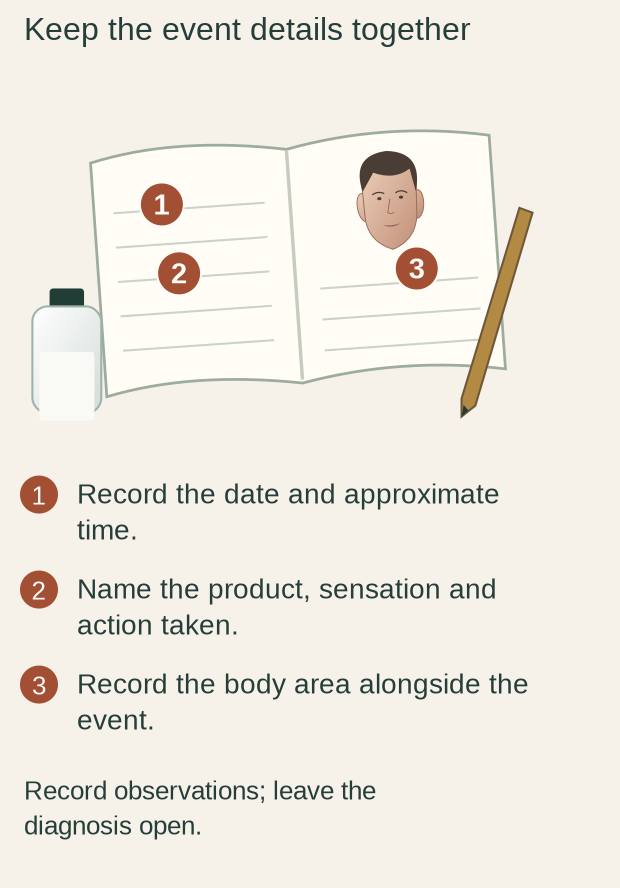
For an example, you could record “Tuesday evening; new cosmetic serum; both cheeks; stinging; stopped using it.” Add a photograph or a clinician’s instruction if you have one, keeping those separate from your own interpretation.
If you changed several products at once, state that plainly. A messy but accurate history helps more than a neat story that singles out one item without enough evidence.
Leave the cause open
Stinging alone doesn’t tell you which ingredient is responsible. The AAD’s contact dermatitis overview explains that finding the cause of a skin reaction can be challenging and that dermatologists investigate irritants and allergies.
That is a good reason to avoid announcing that you are allergic to an entire ingredient category based on one evening. You can say “this product felt uncomfortable” while leaving the medical explanation undecided.
Don’t try to confirm a suspected cause by deliberately reapplying a cosmetic that already caused a concerning reaction. Bring the information to a professional instead of creating another exposure for the sake of certainty.
Online descriptions can help you formulate a question, but they can’t examine you. Keep the question in question form when you write your notes.
Keep prescribed care in a separate conversation
If your routine includes a prescription, tell the prescriber what you used alongside it and what you noticed. Ask whether the sensation is expected for your particular treatment and what changes, if any, they recommend.
Don’t substitute an internet routine for that answer. The right instructions can depend on the prescribed product and your circumstances, which this article cannot assess.
Write the reply in a clearly marked place with the date. You want the next evening’s routine to follow the professional plan, not a confusing mixture of that plan and earlier guesses.
Prepare a focused appointment summary
Start with a one-sentence reason for the visit, then show your timeline and relevant packages. You can explain whether the discomfort is recurring, whether you have noticed visible changes, and what you stopped or changed.
Ask what you should use while the issue is assessed and what should remain paused. Request clarification if an instruction such as “keep it simple” leaves you unsure which of your actual products it includes.
You can also ask what symptoms should lead you to seek care sooner and whether any testing is appropriate. Those are specific questions that help turn a general conversation into usable next steps.
Delay the replacement-shopping spiral
A reaction can make every soothing-looking jar seem urgent. Before you buy, ask whether the purchase answers a confirmed need or mainly gives you something to do while you’re worried.
You can save a product name without ordering it. Keep any replacement ideas in a separate list so they don’t become accidental additions to the routine you’re trying to understand.
Be cautious about claims that a brief sting is required for a product to work. Your comfort is worth discussing, and an unpleasant sensation isn’t a performance measurement you should try to increase.
Keep your account easy to share
Before a call or appointment, read your note once and remove statements you cannot support. Replace “the new ingredient caused this” with the actual sequence of use and symptoms, keeping the product name beside the date.
If someone helped you apply a product or remembers a step you forgot, add that detail as their recollection. You don’t have to make every uncertain point agree before presenting an honest timeline.
A clear account also helps you follow up later: you can explain what happened after a clinician’s instructions without rewriting the original history. Keep new observations dated so the first episode and later changes remain distinct.
Make future changes easier to explain
Once you have an appropriate plan, keep an updated list of the products you’re actually using. If you introduce a new cosmetic later, record its name and date instead of relying on memory.
You don’t need a permanent diary if your routine is settled and comfortable. A few useful records are enough to prevent the next question from starting with “I changed a lot of things, but I can’t remember what.”
The practical goal is clear information and appropriate care. Pause the questionable experiment, preserve the facts, and let medical questions receive a medical assessment.