The mineral-versus-chemical debate can make choosing sunscreen sound like taking sides. You will get further by reading the active ingredients, checking the protection information, and deciding whether the entire formula fits the way you need to use it.
Here, organic filters means the category often called chemical filters in sunscreen discussions. It does not mean a product has agricultural organic certification, and it does not give you a shortcut for deciding whether a particular bottle is suitable for you (Filter terminology in the published abstract). (FDA: Organic cosmetics)
Find the active ingredients before interpreting the front
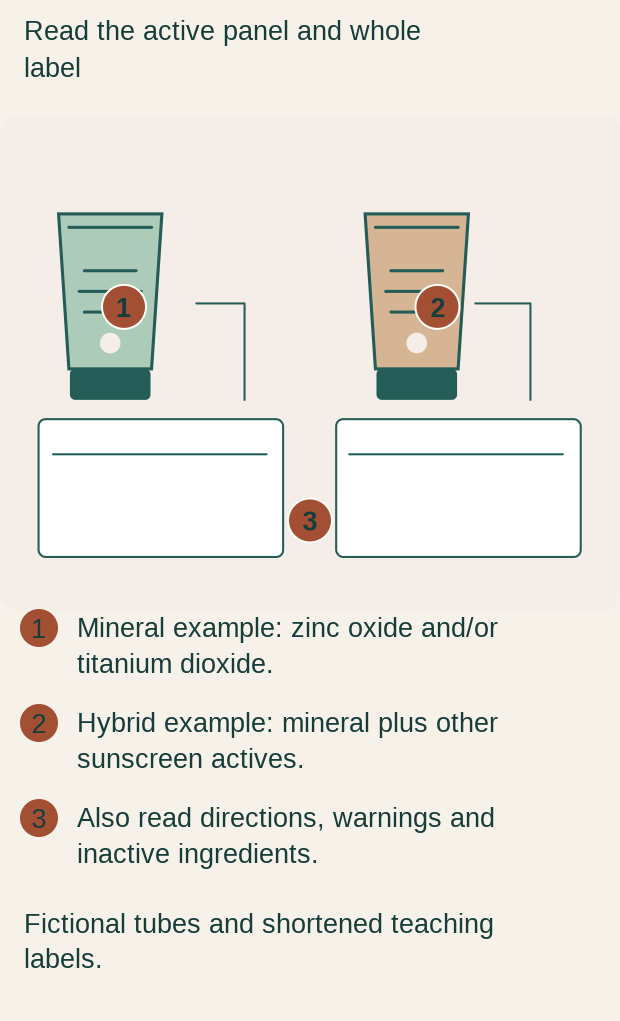
The American Academy of Dermatology describes mineral sunscreens as those using zinc oxide, titanium dioxide, or both as their sunscreen actives. Hybrid formulas combine mineral and chemical actives, so a product can include both categories rather than fitting a strict either-or story (AAD label guide).
The AAD also explains that these sunscreen categories absorb the sun’s rays, while mineral filters additionally reflect them. The familiar claim that every mineral formula only reflects light and every chemical formula only does something else is an oversimplification (AAD explanation).
To identify your bottle, turn it around and find Active ingredients in the Drug Facts panel. Do not treat a highlighted mineral on the front, a leafy logo, or a pastel package as a complete description of all the sunscreen actives inside.
If the tiny print is hard to read, use your phone camera or find the manufacturer’s exact product label online. Match the full name and version before comparing, because a similar-looking tube may represent a different formula.
Use the rest of Drug Facts as your shopping map
The FDA describes a consistent Drug Facts format for over-the-counter medicines. It separates active ingredients and purpose from uses, warnings, directions, inactive ingredients, and other information such as storage instructions (FDA Drug Facts guide).
That structure makes a side-by-side comparison more useful than arguing about the category name. You can check the same sections on two bottles and see whether you have actually gathered the information needed to choose and use either one.
Start with the stated protection features and intended use, then read the directions and warnings. Filter identity is one part of that record, not a replacement for the rest of it.
In its sunscreen-label guide, the AAD recommends broad-spectrum protection, SPF 30 or higher, and water resistance. It says mineral, chemical, and hybrid options can provide effective protection when appropriately selected and used (AAD recommendations).
If you are shopping for a particular outdoor activity, check the exact label rather than relying on the word sport or the feel of a thick cream. You want a product whose instructions match what you will actually be doing.

Compare whole formulas rather than isolated percentages
Two products that share an active ingredient can still come in different textures, shades, packages, and inactive-ingredient lists. Read what is present on the labels instead of predicting that every formula in one category must look or feel identical.
A percentage beside a filter name also does not give you a do-it-yourself method for calculating the finished product’s SPF. Compare the finished products’ labeled protection information rather than inventing a ranking from a single ingredient line.
Imagine two fictional bottles with the same mineral active: one is a tinted cream in a small squeeze tube, and the other is an untinted lotion in a larger bottle. You still need to ask which application experience, tint, and package work for your intended use.
Now imagine a hybrid product beside them. Its category alone cannot answer whether its finish matches your preferences, whether you can follow its directions comfortably, or whether it contains an ingredient you have been told to avoid.
This is why a sensible comparison note has several fields rather than one winner column. Record the full product name, protection labeling, relevant directions, complete ingredient list, package size, and practical questions you still cannot answer.
Treat finish as something to observe
A sunscreen can be suitable on paper and cosmetically frustrating on your face. You can acknowledge a white cast, an unwanted sheen, a tint mismatch, or an awkward texture without turning your experience into a universal verdict about all filters of that type.
If you have access to an appropriate sample, check the appearance at the application amount required by the directions. An almost invisible trace on your wrist tells you little about the finished look of a normal application.
Use the other products you ordinarily wear when assessing how the routine fits together. If you change your moisturizer, makeup, and sunscreen on the same morning, it becomes harder to say which combination created an unwanted cosmetic result.
Keep that observation modest: you are seeing whether this routine suits you. You are not measuring sun protection, diagnosing an allergy, or proving that an entire category behaves the same way for everybody.
The AAD recommends mineral options for sensitive skin, but that recommendation does not certify that every mineral formula will suit every individual. If you have a history of reactions, get help with your specific history and the actual product ingredients (AAD sensitive-skin advice).
Original concept illustration. Two fictional sunscreen tubes with enlarged mineral and hybrid active-ingredient teaching panels. It is not a clinical assessment or a product certification.
Separate filter chemistry from marketing language
The word organic can create confusion because it carries a different meaning on agricultural certification labels. In a filter discussion, ask what category the writer is describing before assuming that the word refers to how ingredients were grown.
Likewise, a product that advertises a short list of excluded ingredients has not necessarily answered your practical questions. You still need to know what it contains, what its labeling says, and whether you can use it as directed.
You can decide to follow a personal ingredient preference without describing every alternative as dangerous. A preference is an honest basis for narrowing your shopping list, while a broad safety claim needs evidence about the actual ingredient, exposure, and use.
If a headline says that one ingredient is under review, read the current primary source and its scope. Do not assume that a question about additional data means every product in a broad category has been prohibited or that a different category never needs scrutiny.
This guide does not supply a permanent inventory of allowed US sunscreen ingredients. Regulations and available formulas can change, so current product labeling and current FDA information are more useful than an old ingredient chart passed around online.
Build a short comparison you can finish
Choose two or three actual products instead of opening dozens of tabs. Start by excluding options whose relevant warnings, directions, unavailable labeling, or known ingredient restrictions leave important questions unresolved.
For the remaining options, compare practical fit: can you afford to replace it, get it again, carry it where needed, and use the amount and frequency described? These questions do not establish laboratory superiority, but they can make a purchasing decision much clearer.
If one product seems right for daily wear and another for a particular outing, you do not have to force a universal champion. Keep each bottle’s instructions attached to that bottle rather than borrowing the directions from the other.
Before buying, confirm which size, tint, and version are actually in the cart. Save the product page or photograph the package so that your next order does not depend on remembering only a brand name and a color.
Know what a label comparison cannot settle
A label cannot diagnose why your skin stings, explain a persistent rash, or tell you which medical treatment you need. If a product causes a concerning reaction, stop and follow its warnings rather than treating repeated discomfort as a challenge to overcome.
A pharmacist or dermatologist can help you work through a specific ingredient or use question. Bring the actual package and describe what happened, instead of reporting only that a mineral or chemical sunscreen did not work for you.
For an ordinary shopping choice, keep the process grounded: identify the actives, read the whole label, and assess the complete formula’s fit. That gives you a useful decision without fear-based rankings or claims that a single word on the front can answer everything.
Photo Credits
- Turn the package around and compare its actual details; this stock scene does not identify or recommend a sunscreen. Photo: Sam Lion, Pexels.