If your face looks shiny but feels tight after washing, skipping moisturizer is not automatically the answer. Oily appearance and comfort are different observations, and you can choose a workable moisturizing texture without committing to a heavy finish.
You also do not need to decide your permanent skin type from one afternoon in a mirror. Start with what you notice during an ordinary day and build a simple routine around the products you can use comfortably.
Separate what you see from what you feel
Shine is something you can observe on the surface, while tightness, stinging, or discomfort is a sensation you can describe. Those observations can happen together without telling you exactly why they are occurring.
The American Academy of Dermatology recommends moisturizing after cleansing even for oily skin. Its guidance also cautions that a harsh face wash can irritate skin, so trying to force a completely squeaky feel is not a useful target. (AAD: How to control oily skin)
You do not need to call your skin dehydrated to justify using a moisturizer. A term you find online is less useful than knowing which part of your routine feels uncomfortable and explaining it accurately.
If you have persistent irritation or acne that is difficult to manage, a dermatologist can help assess the situation. A general article cannot determine whether the product, a medication, or another condition is responsible.
Check the cleanse before blaming the cream
Think about how you wash, including how often you repeat the step and whether you scrub to remove every trace of shine. The AAD advises gentle cleansing rather than aggressive rubbing.
More cleansing is not automatically a better response to an uncomfortable finish. If you repeatedly wash because your face looks glossy, you may be creating a cycle of extra steps without answering your original question.
Follow your cleanser’s directions and any treatment plan you already have. You can ask a pharmacist whether your cleanser and moisturizer are a sensible combination instead of adding a stronger product on your own.
Write down the moment discomfort appears: during washing, immediately afterward, or later with another product. That timing will not diagnose the cause, but it gives you a clearer question to investigate.

Choose a finish you can live with
A moisturizer does not have to leave a rich, obvious coating to count as a moisturizer. You can compare a light lotion or gel texture if a substantial cream makes you reluctant to complete your routine.
Look for the intended facial use and read the complete directions, including any warnings. Packaging that says lightweight may help narrow a search, but it does not prove how the formula will feel on your skin.
The AAD suggests looking for oil-free and noncomedogenic labeling when choosing products for oily skin. Treat those terms as selection clues rather than a personal guarantee that no product will ever cause a problem.
If you already own a suitable moisturizer, check whether its practical issue is really the formula or the way the package fits your day. A hard-to-control dispenser can make it difficult to apply consistently even when the contents are acceptable.
Keep moisture and surface oil conceptually separate
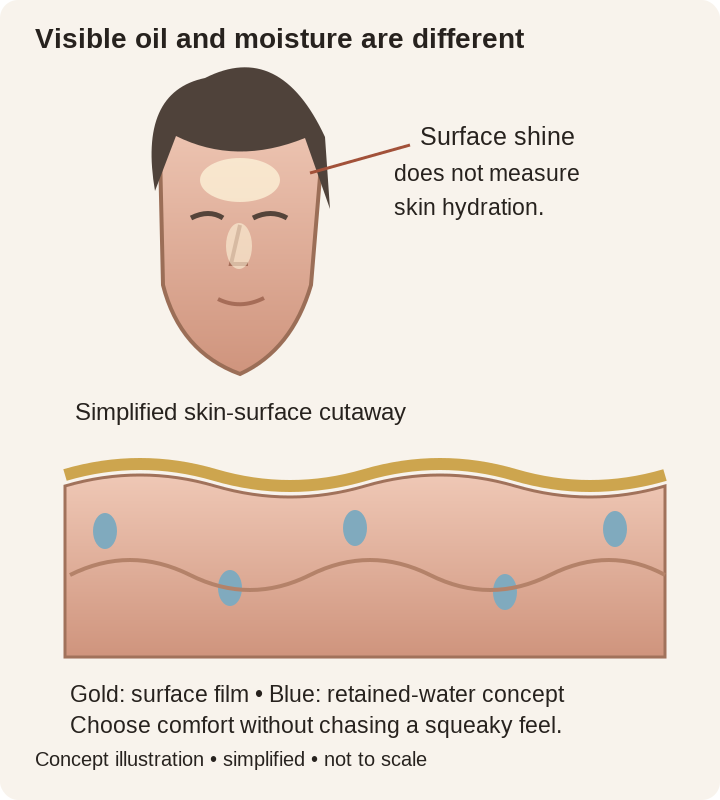
DermNet describes moisturizers as formulas that may combine water-attracting ingredients, surface-softening ingredients, and ingredients that slow water loss. That combination is different from simply adding more visible oil to a face. (DermNet: Emollients and moisturisers)
This is why the phrase moisturizing oily skin does not have to mean choosing the greasiest product on the shelf. The complete formula and your experience with it matter more than a single texture stereotype.
The illustration separates a visible surface film from moisture-related functions in a simplified cutaway. It is a teaching concept, not a measurement of your skin or a way to identify a clinical problem.
You should not use a mirror, a tissue test, or a diagram to claim that you have proved a damaged barrier. If discomfort is persistent, bring the observation to a qualified professional.
Make the morning routine coherent
Picture the actual order of your morning: washing if appropriate, applying the products you use, and getting ready for outdoor time. A moisturizer that feels fine alone but inconvenient beside the next labeled product may not fit that particular moment.
Keep sunscreen separate and follow its own directions rather than mixing it with moisturizer to make the finish lighter. If you prefer a moisturizer with sunscreen, check the sunscreen labeling and use it as directed.
You do not need a separate serum merely to make a simple moisturizer feel more sophisticated. Each extra layer adds another texture to assess and another possible source of inconvenience.
If makeup is part of your routine, evaluate the combination you actually wear on ordinary days. A useful choice is one that works with your habits, not one that looks good only during an empty-calendar trial.
Avoid making every shiny moment a reset
You may notice shine during the day even when your routine feels comfortable. That observation alone does not mean you need to wash again, add acid, or replace the moisturizer immediately.
The AAD suggests gently pressing blotting paper against oily areas rather than rubbing it across the face. If you use it, keep the action gentle and avoid turning it into repeated scrubbing.
A practical midday plan might simply be carrying whatever you need for your labeled sunscreen routine and leaving unnecessary skin-care bottles at home. You can choose a routine that is manageable without trying to make your face look identical all day.
There is no requirement to treat a natural-looking finish as failure. Your priorities might be comfort, clear directions, and ease of use rather than eliminating every visible reflection.
Compare one change at a time
If you want a different moisturizer, explain the desired change in ordinary words: less tacky before sunscreen, easier to dispense, or less substantial on the forehead. Those descriptions are more useful than asking for a product that fixes oily skin forever.
Choose a manageable package and avoid changing the cleanser and several other products at the same time. You will have a clearer idea of which practical problem the replacement does or does not solve.
Do not create an elaborate test that requires ignoring irritation or applying unsuitable products to different halves of your face. You are making a careful everyday choice, not running a clinical trial.
Keep the name and ingredient label of the product you try so you can discuss it if needed. A picture of an unlabeled jar is much less helpful than knowing the exact version you used.
Consider different areas without overengineering
Your forehead, cheeks, and the area around your mouth may not feel identical. You can notice those differences without buying a separate routine for every small region.
Follow the product’s directions and ask for advice if you are unsure how it belongs alongside acne treatment or another prescribed product. A plan that seems simple on a shelf can become confusing when several medicated formulas are involved.
Be especially cautious about treating flaky or irritated areas as an invitation to exfoliate more. If the appearance is persistent or accompanied by discomfort, get help understanding it rather than adding friction.
You can also prefer one texture in warm weather and another when conditions change. A useful routine can adapt without forcing you to assign a permanent label to your skin.
Know when product selection is not enough
Seek professional guidance for persistent pain, rash, troublesome acne, or discomfort that does not settle with a sensible routine. You do not need to keep buying increasingly expensive moisturizers before asking for help.
Bring a short timeline, your actual product names, and any treatment instructions you follow. Describe what you saw and felt without deciding in advance that a particular ingredient must be responsible.
If your current moisturizer is comfortable and fits your day, you can keep it even if its marketing is less exciting than the next release. The useful result is a routine you can maintain, with gentle handling and realistic expectations about normal-looking skin.
Photo Credits
- A workable texture can fit into a straightforward facial routine. Stock photograph by Sora Shimazaki; illustrative context.