You can choose a moisturizer by asking two questions: how much dryness are you dealing with, and what texture will you actually use where you need it? Lotion, cream, and ointment describe useful starting points, but the name alone cannot tell you whether a particular formula will feel right.
If your current moisturizer is comfortable and doing its job, you do not need to graduate to a thicker product. If you avoid it because it feels sticky, or keep reaching for more because your skin still feels tight, you have a practical reason to reconsider.
Start with the broad texture differences
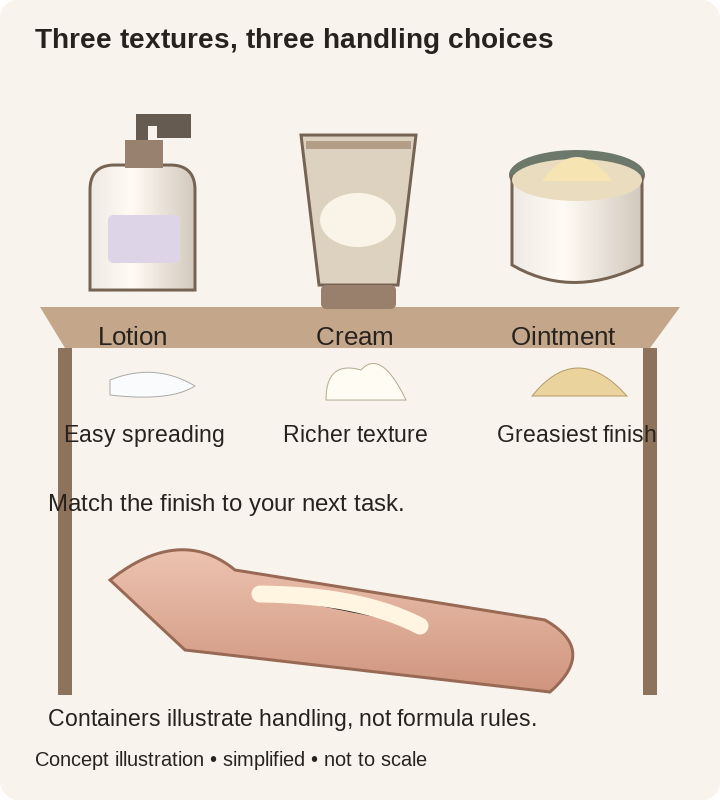
A lotion usually spreads easily and feels lighter, a cream is generally richer, and an ointment is usually the greasiest option. The American Academy of Dermatology describes this progression while stressing that moisturizer choice depends on your skin and the degree of dryness. (AAD: How to pick the right moisturizer) (DermNet: Emollients and moisturisers)
These categories overlap between brands, so you should not expect every cream to feel the same. A squeeze tube might contain a substantial cream, while a jar might hold a fairly light formula.
Think of the words as directions to a shelf, then read the actual package. Check the intended body area, directions, fragrance information, and any warnings before choosing what belongs in your routine.
A rich texture is not a guarantee of superior ingredients, and a light texture is not evidence that a product is ineffective. Your decision needs to include the complete formula and how it fits your day.
Match the texture to a real moment
Picture getting dressed for work after a shower, with a shirt already laid out and only a few minutes available. You might prefer a spreadable cream or lotion because an ointment leaves more residue than you want under those clothes.
Now picture caring for a small dry-feeling spot while you are relaxing at home. A heavier product might feel less inconvenient then, especially if you do not immediately need to hold a phone, keyboard, or steering wheel.
Neither scene establishes a medical recommendation for your particular skin. It simply shows why the same person might reasonably want different textures for different circumstances.
Before buying, finish this sentence: you will use this on this body area, at this time, before doing this next activity. That sentence is often more helpful than choosing whichever label promises the most luxurious finish.

Compare what happens during ordinary use
If you already own a suitable moisturizer, notice whether it spreads without prolonged rubbing and whether its finish bothers you afterward. You can write a plain observation such as comfortable under sleeves or too slippery before handling dishes.
Keep comfort separate from appearance when you make that note. A visible sheen may be acceptable to you at night, while a product that looks invisible can still feel unpleasant on your hands.
Avoid turning a texture comparison into a challenge to tolerate discomfort. Burning, a new rash, or worsening irritation is a reason to stop experimenting and ask a qualified professional for advice.
You do not need a complicated scoring system, but you do need a fair comparison. If you change the cleanser, shower temperature, moisturizer, and application timing together, you will have little idea which adjustment made a difference.
Know the jobs behind the ingredient names
Moisturizers can combine ingredients that attract water, soften the surface, and slow water loss. Those roles can exist in the same formula, which is why a single highlighted ingredient cannot describe the whole product.
You might see glycerin on a lotion label and petrolatum on an ointment label, for example. That is useful information, but you still cannot calculate a finished product’s performance from those names alone.
Treat claims such as barrier support as a prompt to examine the formula and directions, rather than as a diagnosis of a damaged barrier. A moisturizer label cannot explain every possible reason for dryness or discomfort.
The illustration below is a simplified way to compare texture and handling, not a microscopic measurement of particular products. Its purpose is to connect what is in your hand with what you need to do next.
Let the body area influence your choice
A product that is pleasant over your lower legs may feel too substantial on your face. Check whether the manufacturer intends the product for both areas instead of assuming all moisturizers are interchangeable everywhere.
Hair, clothing, and movement also affect convenience, even when you are thinking only about ordinary cosmetic care. You might value easy spreading over a large area and a more contained application on a small spot.
For hands, consider what follows immediately after application. A tube you can reopen easily and a finish you can tolerate around daily tasks may be more useful than a large jar you leave untouched.
For facial care, think about the products that must sit alongside the moisturizer. You can compare whether your chosen formula is convenient with your sunscreen without mixing the two together or changing the sunscreen’s labeled application.
Buy the package you can manage
A pump can make a large bottle convenient near your usual application spot, while a tube can fit into a bag or a small bathroom drawer. Neither package tells you by itself how rich the contents will feel.
If you use a tub, follow clean handling practices and keep the container closed between uses. The NHS advises using a clean spoon or spatula to remove emollient from a pot rather than contaminating the contents. (NHS: Emollients)
Consider whether you can grip the package comfortably and read its directions without struggling. A purchase that depends on awkward twisting or a tiny label might create an unnecessary obstacle every time you use it.
There is also a difference between the cheapest ounce and the most sensible purchase. A smaller package you finish can be a better practical choice than a bargain tub of a texture you strongly dislike.
Make one useful swap
Suppose your lotion is easy to use but leaves you repeatedly wishing for a more substantial finish on your legs. You could compare a straightforward cream intended for that area while leaving the rest of your washing routine unchanged.
Suppose your ointment feels fine on a small area at home but makes you avoid moisturizing your hands during the day. You could ask a pharmacist about a more manageable daytime option instead of abandoning hand care entirely.
Choose a small package when practical, keep its label, and avoid buying several competing formulas at once. You are trying to answer a specific question about usability, not assemble a complete collection of textures.
Notice both the immediate experience and whether the product remains workable in ordinary life. If you constantly wipe it away before finishing your next task, that inconvenience belongs in your decision.
Keep safety and persistent symptoms in view
Moisturizing products can leave floors and tubs slippery, so keep application away from a wet walking surface and clean spills promptly. The NHS also warns that fabrics containing emollient residue can catch fire more easily around flames and cigarettes.
Do not use a heavier texture as a substitute for getting persistent, painful, cracked, or bleeding skin assessed. You also should not apply an ordinary cosmetic product to an unexplained wound or rash simply because its label sounds gentle.
If you have a prescribed skin treatment, ask your clinician or pharmacist how the moisturizer fits around it. Texture preference does not override treatment instructions or establish which products should be combined.
For everyday selection, your best next step is usually modest: identify one inconvenient or inadequate part of your current routine, then choose a suitable texture to address that specific issue. You can keep the rest of your shelf exactly as simple as it already is.
Photo Credits
- Choose a texture you can use comfortably during your actual day. Stock photograph by Hanna Pad (Anna Nekrashevich); illustrative context.