Fragrance-free and unscented sound like interchangeable shortcuts when you’re choosing skin care. Before you treat them as the same promise, turn the package around and check what the manufacturer actually tells you.
The practical goal is to understand your purchase, not to win a vocabulary argument. If you’re avoiding a known allergen, the exact ingredient information and your clinician’s instructions matter more than a reassuring phrase on the front.
Start with the important difference
The FDA explains that an unscented product can still contain fragrance ingredients. A manufacturer may use them to mask the smell of other ingredients without giving the finished product an obvious scent.
That means “I can’t smell anything” isn’t the same observation as “the formula contains no fragrance ingredients.” Keep those two questions separate when you compare a bottle you already own with a possible replacement.
Fragrance-free is a useful label to look for when you want to avoid added fragrance, but it doesn’t answer every question about a formula. You still need the current ingredient list and any information relevant to your own avoidance instructions.
You also don’t need to assume that a product with a faint ingredient smell is mislabeled. If the wording and your experience seem inconsistent, ask the manufacturer what the claim covers rather than relying on your nose alone.
Read the front and back together
Start by recording the exact front-label wording. A product may say fragrance-free, unscented, lightly scented, or something less specific, and paraphrasing it too early can hide a difference you wanted to check.
Next, find the ingredient declaration on the actual package or its outer carton. Look for fragrance information there, while remembering that you aren’t reconstructing the entire formula from a brief list.
The FDA says fragrance mixtures may be listed simply as fragrance, rather than naming every component. That limits what you can conclude from a label when you’re trying to identify a particular substance.
If your clinician gave you an avoidance list, keep the exact names accessible on your phone. It is easier to compare that list directly than to remember a few fragments while you’re scanning tiny print.
Your routine can stay simple while you check one labeling question at a time; stock scene, not a product trial.
Picture what the wording leaves open
Imagine two fictional bottles sitting side by side on your counter. Bottle A says unscented, while Bottle B says fragrance-free, and both are described as everyday moisturizers.
You can’t decide they are equivalent just because neither has an obvious perfume smell when opened. The information you need is about the formula and the claim, not only the experience of smelling the contents.
Illustrative packaging shows why you should read the claim alongside the ingredients; it does not identify a real formula.
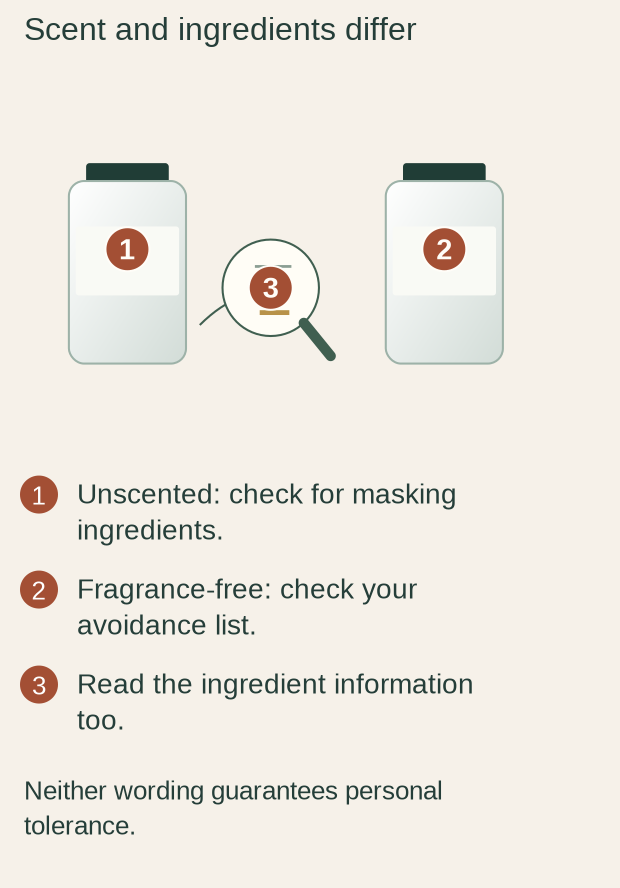
The diagram deliberately leaves some details unanswered. That is what an honest comparison sometimes looks like, and you can resolve a useful uncertainty with the manufacturer instead of filling it with an assumption.
Don’t substitute a neighboring claim
A label saying natural, botanical, or hypoallergenic doesn’t directly answer whether fragrance ingredients are present. Treat each claim as a separate item rather than letting several reassuring words merge into one general impression.
The FDA states that hypoallergenic has no federal standard or definition. It doesn’t provide a personal guarantee that a cosmetic will agree with your skin.
For a practical comparison, write the fragrance wording on one line and any other claim on another. You can then see whether the second line adds relevant information or mainly repeats the feeling the package wants to create.
If a product features a flower or leaf on the box, don’t use the artwork as an ingredient declaration. Open the readable label information and let the illustration remain an illustration.
Ask a question the manufacturer can answer
A useful inquiry names the exact product and version, includes a photograph of your label, and explains the detail you need clarified. Ask whether this exact unscented formula contains ingredients used to mask odor, rather than asking a vague question about whether it is clean.
If you need information about a particular ingredient, name it exactly and explain that you are checking the current US package. Similar product names and older website photos can otherwise make the reply difficult to apply.
Keep the answer with the date and the product details. If you buy a different size, variant, or reformulated version later, you can see what the old answer actually covered rather than assuming it covers everything the brand sells.
You don’t need to share a full medical history with customer service to ask a labeling question. For medical suitability, bring the label and any manufacturer response to your own qualified clinician.
Make a short comparison that you can use
Suppose you’re replacing a body lotion because you prefer to avoid added fragrance. Your shortlist can begin with the exact claim, the current ingredient information, the package size, and the type of dispenser.
Record “unclear” when you can’t answer a question from the available information. That entry tells you where another message or a different product would save time, rather than encouraging you to debate an unreadable thumbnail.
You might end up with a fragrance-free lotion in a small tube that is easier to try within your budget. That is a practical purchase decision, not evidence that it is the safest formula for every reader.
Another person may need to avoid a specific ingredient and require a more detailed answer before buying. Your preference-based shortlist should not be reused as that person’s allergy plan.
Keep household communication clear
If someone else shops for your products, share the exact name and a label photograph. “Get the unscented one” can be ambiguous when the store carries several nearly identical bottles.
Write down whether a substitute is acceptable before the shopping trip. You can say “please ask me before replacing this” if the distinction matters, without requiring the shopper to interpret a long ingredient list under pressure.
For a shared bathroom, keep products in their labeled containers and avoid swapping their caps or contents. That makes it easier for everyone to identify what they are reaching for and preserves the information you may later need.
Keep a reaction separate from a label debate
If a product causes a troubling reaction, the immediate task is appropriate care, not proving which marketing word was responsible. Stop experimenting with the suspect cosmetic and seek professional advice when symptoms are significant, persistent, or recurring.
Record the product name and what you observed without declaring fragrance the cause. A label can help a clinician investigate, but your experience alone doesn’t identify an ingredient or distinguish every possible explanation. (Contact dermatitis overview)
Don’t test the theory by repeatedly applying a product that has already caused a concerning reaction. Keep its information available and discuss what happened with a qualified professional.
Keep old information in its place
Save a screenshot of the current ingredient information with the date and exact product name. If an older review or search result describes different wording, compare it against the package you would actually buy instead of combining the two versions.
You can mark the older information as a question for the manufacturer without deciding which version is correct. That keeps a potential formula or labeling change visible and prevents a confident answer based on a package you no longer have.
When you share a recommendation with someone else, include that boundary. Saying that you checked a particular package on a particular date is clearer than promising the entire product line will always have the same fragrance information.
Use the wording as a starting point
On your next shopping trip, give yourself a short task: read the exact claim, check the ingredient information, and identify anything you still need to ask. You can do that without becoming a cosmetic chemist.
If the answer stays unclear, choosing another product or postponing the purchase is reasonable. A crowded shelf doesn’t require an immediate decision, especially when the missing detail is the one you care about most.
The useful distinction is straightforward: an absence of obvious scent doesn’t establish an absence of fragrance ingredients. Keep that fact beside your personal requirements, and your comparison becomes much easier to use.