Dry-feeling hands can turn small tasks into recurring annoyances: a tight feeling after washing, a rough patch that catches on fabric, or a cream you keep forgetting until bedtime. A useful routine needs to fit between the things your hands already do.
Start by keeping appropriate hand hygiene in place, then make moisturizing and task protection easier to remember. You do not need a ten-product ritual, and you do not need to decide on your own that every patch of discomfort has the same cause.
Keep cleaning your hands at the times that matter
CDC recommends washing with soap and clean running water at key times, including around food preparation, after using the toilet, and after handling garbage. Its basic method includes lathering all hand surfaces, scrubbing for at least 20 seconds, rinsing, and drying (CDC handwashing guidance).
If soap and water are not readily available, CDC recommends an alcohol-based hand sanitizer containing at least 60% alcohol. Follow its guidance for the situation rather than substituting a skin-care preference for necessary hygiene (CDC sanitizer guidance).
Dryness is a reason to improve the care around washing, not a reason to skip important washing moments. If your work has infection-control or food-handling requirements, keep those rules in the picture when you plan the rest of your routine.
You can make the washing station more convenient without changing its purpose. Check that soap, a suitable drying option, and your moisturizer are accessible, so you are not searching a drawer with wet hands.
Put moisturizer where the habit happens
The American Academy of Dermatology recommends using moisturizer after handwashing and when hands feel dry, and describes applying it while the skin is still damp. It also recommends fragrance-free, dye-free cream or ointment for hand comfort in dry conditions (AAD hand-care advice).
Choose a package you can open and close easily at the moment you need it. A beautiful jar on a distant bedroom shelf may be less useful during the day than a straightforward tube beside the sink.
If you use several sinks, decide which one is your main hand-care station. You can add a portable product for the other locations if that helps, but start with a setup you can actually maintain.
At work, keep the product where your workplace permits it and read any rules about products used around food, patients, machinery, or shared equipment. A routine that ignores those requirements will be difficult to sustain.
Think about timing as well as location. A quick pause after washing may be easier than remembering a separate skin-care session between meetings, errands, cooking, and everything else that fills your day.

Find a texture that fits the next task
You may want a different feel before typing than you want when settling down for the evening. That is a practical preference to explore, not a reason to assume that the thickest-looking package must be right for every moment.
Compare products by how they fit your routine while following their own directions. Note whether the cap is awkward, the scent is unwanted, or the finish makes you reluctant to touch your phone, because those details explain why a product gets left unused.
If your preferred option feels inconvenient immediately before handling objects, plan a moment when you can pause. Do not create a slippery grip around tools or other equipment simply to complete a hand-care step on schedule.
Keep any known ingredient restrictions from your clinician in mind. A friend’s favorite cream can give you an idea to investigate, but it cannot answer a specific allergy question or establish that the formula will suit you.
Introduce a new product deliberately enough that you can identify it in your notes. Changing the hand soap, sanitizer, cream, and cleaning gloves together may leave you with more questions if your hands then feel different.
Walk through the wet jobs in your day
List the tasks that repeatedly put your hands in water or contact with household products: washing dishes, wiping counters, laundry, gardening cleanup, and bathing a pet. You are looking for places where the task instructions and an appropriate protective setup need attention.
For cleaning products, read the label for handling precautions and any required gloves. Choose protection for the actual task rather than assuming that any pair in the kitchen drawer offers the same resistance to every substance.
Check the glove maker’s directions, fit, and care instructions, too. A damaged glove or one that makes the tool hard to hold is a practical problem to solve before beginning the job.
Put the supplies together where you will use them. For dishwashing, a designated glove spot and a nearby moisturizer can make the sequence easier to remember than a vague intention to be kinder to your hands.
You do not need to buy a matching organizer to do this. A simple place to dry and store suitable gloves, along with a clear bottle label you can read, may solve the access problem more effectively.
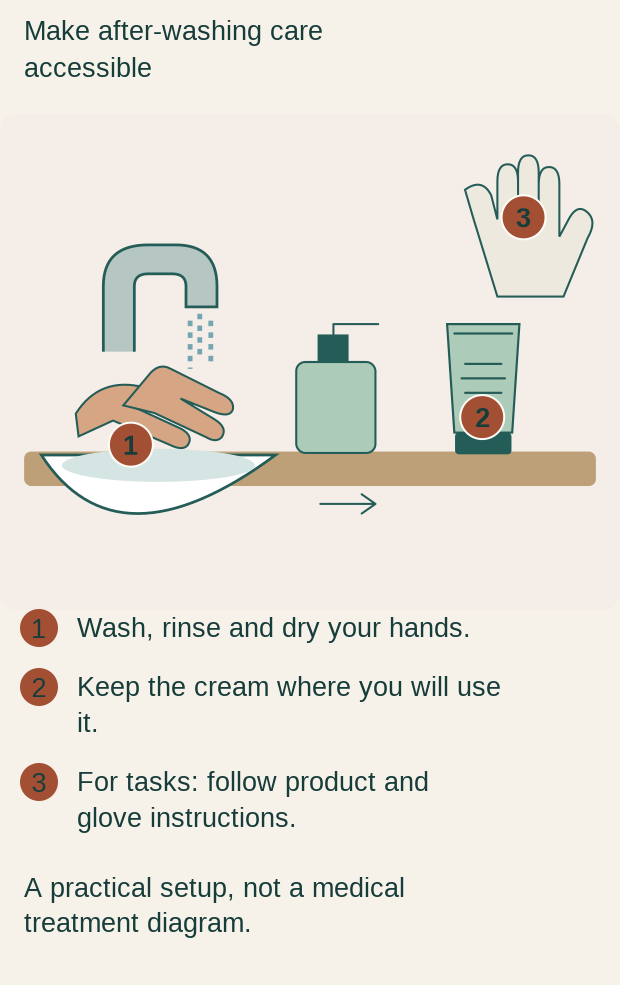
Original concept illustration. A faucet, hands being washed, soap dispenser, nearby cream tube, and task glove illustrate an accessible hand-care station. It is not a clinical assessment or a product certification.
Use the end of the task as a reminder
Choose one existing cue, such as putting away the dish brush, closing your laptop for lunch, or finishing your evening wash. Attach a brief hand-care check to that cue so the routine does not require a new alarm for every small action.
If you use a phone reminder, make it specific enough to help. A note saying that your cream is in the desk drawer provides a clearer next step than an abstract instruction to practice self-care.
Keep a portable tube in an easily identified pouch if your day involves several locations. Check it before leaving home so the thing you remembered to carry is not empty or leaking.
When you return home, put it back in the same place. Reducing the search for the product often makes a bigger difference to a routine than adding another product you will also need to locate.
If your hands feel comfortable and the routine is manageable, resist adding more steps just because a video makes them look appealing. A small habit you can repeat is a reasonable outcome in its own right.
Give evenings a simple role
Use the evening to check your hands and reset the supplies for tomorrow. Refill the soap when needed, replace the empty tube, and move a frequently forgotten product back to its useful location.
The AAD describes an evening hand-care routine with cream or ointment and cotton gloves as one option. You can discuss that approach with your dermatologist if you need help deciding how it fits your circumstances, rather than assuming overnight covering is required for everyone (AAD evening-care option).
Do not turn a comfortable evening routine into a reason to neglect your hands all day. The useful question is whether your current pattern is manageable and whether dryness or other symptoms are persisting despite reasonable care.
Avoid experimenting with household mixtures because they seem soothing in a short video. Keep product use within its directions, especially if the skin is cracked, irritated, or already under medical treatment.
Know when the question has become medical
Dry-feeling skin, a persistent rash, deep cracks, pain, and signs that concern you are not interchangeable descriptions. The AAD notes that severely dry hands can crack and that deep cracks can be associated with infection (AAD dry-hand guidance).
If symptoms persist, worsen, bleed, or interfere with ordinary tasks, seek assessment rather than repeatedly swapping creams. A clinician can help distinguish a routine comfort issue from a condition that needs a different approach.
Bring the exact soaps, sanitizers, creams, and glove information you use, or clear photographs of their labels. Describe when symptoms occur and what tasks seem connected, without presenting your own guess as a confirmed diagnosis.
If a product causes a concerning reaction, follow its warnings and stop-use instructions. Do not keep using it solely because it was marketed for sensitive skin or because it worked for someone else.
Keep the plan small enough for tomorrow
Choose one suitable moisturizer, put it at the place you are most likely to use it, and review the precautions for a frequent household task. Keep necessary washing in place and add a portable option only if your day actually needs one.
After several ordinary days, notice what got in the way and adjust that detail. Your goal is a workable rhythm of appropriate washing, practical moisturizing, and task-specific protection, with professional help when symptoms ask for more than a routine can provide.
Photo Credits
- Keep hand hygiene in place and make the care around it practical; this is an illustrative stock scene. Photo: cottonbro studio, Pexels.