A moisturizer can promise to be clean, natural, and hypoallergenic without answering your most useful question: what does this exact product offer, and does it fit the way you intend to use it? Treat a front-label claim as a starting point for questions rather than a personal safety certificate.
You do not have to become suspicious of every attractive package. You can enjoy a brand’s style while separating the words that describe its marketing position from the specific information you need to compare products, follow directions, and discuss an ingredient concern.
Give hypoallergenic a smaller job
FDA says there are no federal standards or definitions governing hypoallergenic, and manufacturers are not required to submit evidence of that claim to FDA. The word therefore cannot guarantee that you personally will avoid an allergic reaction (FDA hypoallergenic explanation).
If you have a known allergy, begin with the ingredient information and the advice you have received about that allergy. Do not replace that specific instruction with the reassurance you feel when you see a gentle-looking package.
Imagine two creams: one prominently says hypoallergenic, while the other gives you clearer information about an ingredient you need to avoid. You still have to check the actual formula rather than letting the larger word make the decision for you.
If the full list is not visible on a product page, look for the manufacturer’s label or ask for it. A short selection of featured ingredients does not answer whether another ingredient appears elsewhere in the formula.
Ask what natural means in this particular claim
FDA has not established a regulatory definition of natural for cosmetic labeling. Its small-business cosmetics guidance also makes clear that the same safety and labeling responsibilities apply regardless of an ingredient’s source (FDA cosmetic-claims guidance).
That leaves you with a useful question for the brand: what, specifically, is it describing? It might be discussing the origin of selected ingredients, a manufacturing choice, or a preference that does not tell you much about the finished product’s use.
A specific answer is easier to evaluate than a general impression. For example, a brand might identify a plant-derived ingredient, but that fact alone does not describe every other ingredient or tell you how the complete formula will feel on your skin.
You can prefer a particular ingredient source for personal reasons without upgrading that preference into a claim that every alternative is harmful. Keeping those ideas separate makes your shopping criteria clearer and your expectations more realistic.
Keep organic certification separate from comfort
The FDA explains that USDA’s National Organic Program has rules for organic agricultural claims, while FDA’s cosmetic safety and labeling responsibilities still apply. It also states that an ingredient’s source does not determine whether it is safe (FDA organic-cosmetics explanation).
If certification matters to you, check exactly what is certified and by whom. Do not assume that a leaf illustration or the word botanical proves compliance with a particular certification program.
A certification can answer a question within its stated scope without answering every question you have about the product. You may still need to consider texture, fragrance preferences, packaging, directions, and any ingredient restrictions relevant to you.
This is especially useful when comparing products with different priorities. One may better match a sourcing preference while another is easier for you to use, and you can acknowledge that tradeoff without declaring one universally better for everyone’s skin.
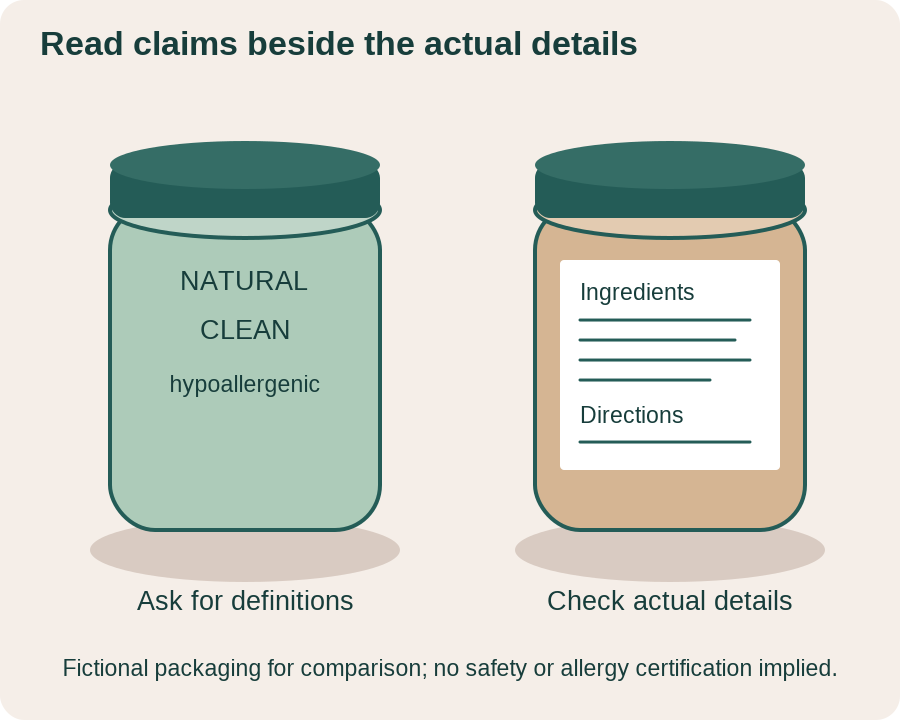
Turn clean into a request for a definition
When a brand calls a product clean, find its published definition rather than supplying your own. A retailer’s screening policy, a brand’s excluded-ingredient list, and a shopper’s personal meaning may be different things.
Check whether the claim concerns the whole product or a selected feature. A statement about packaging, for example, should not quietly become evidence about allergy risk or the outcome you will get from the contents.
An exclusion list also leaves unanswered questions about what is present. If a product advertises that it is free of several unfamiliar names, you still need the complete ingredient information and the directions for the formula being sold.
You do not need to settle every debate about the word before making a modest purchase. You need enough specific information to decide whether the product meets your own relevant criteria, and you can leave a question unresolved when the brand has not answered it.
Distinguish a promise from evidence of an outcome
Look at the exact outcome being claimed rather than collecting impressive adjectives. A statement that a cream feels lightweight is different from a claim that a defined group experienced a measurable change over a specified period.
If a brand mentions a study, look for the participants, product version, outcome measured, duration, and comparison used. When those details are missing, record that limitation instead of imagining the strongest possible interpretation.
A percentage can sound precise while leaving the question unclear. Ask whether it refers to participants’ opinions, an instrument measurement, or another defined result, and whether you can see what those participants were actually asked.
Likewise, an expert’s name or a professional-looking coat in a photograph does not explain the scope of a review. Find out what was evaluated before treating an endorsement as evidence for every statement on the package.
You can decide that the available information is sufficient for a simple cosmetic preference without claiming it proves more. A purchase decision and a scientific conclusion do not need to be the same size.
Original concept illustration. Fictional cosmetic jars contrast front marketing claims with back ingredient and direction details. It is not a clinical assessment or a product certification.
Use a short comparison note at the store
Start your note with the job you want the product to do, such as providing an everyday moisturizer in a package you can carry. That keeps you from comparing a basic cream with an entirely different product just because both use the word natural.
Next, record the full name, size, price, ingredient information, and directions you can actually find. Put unanswered questions in a separate line so that attractive marketing does not silently fill the gaps.
Then add your practical preferences, such as a squeeze tube, a particular texture, or availability at a nearby store. These are legitimate shopping considerations even though they do not establish that the product is medically superior.
Finally, write the claim and your translation of its limited meaning. For example, you might note that a brand describes its own exclusion policy, while your personal ingredient question still needs the complete list.
This process works just as well online, where you can save the exact page and check that the item in your cart is the same version. A brand can sell several similar products, and an enthusiastic review of one does not verify another.
Keep reactions separate from marketing disappointment
If you develop a concerning reaction, follow the product’s warnings and seek appropriate medical advice. Do not keep applying it because its label seems to promise that a reaction should be impossible.
Save the package and ingredient list so you can accurately describe what you used. If you changed several products together, note that history rather than deciding immediately which marketing term or ingredient category explains everything.
A disappointing texture or scent is also worth recording, but it is a different kind of observation. You can dislike a formula without labeling it toxic, just as a formula you enjoy does not prove that nobody else could react to it.
If you already have a diagnosed skin condition, keep your clinician’s recommendations central. A broad consumer label cannot replace advice that takes your medical history and symptoms into account.
Leave the shelf with a specific reason
Your best reason for choosing a product should be something you can state plainly. You found the ingredient information, checked the directions, considered your own restrictions and preferences, and chose a formula whose practical fit you understand.
The large claims can remain part of the package without becoming guarantees in your head. Once you know which question each term can answer, you can shop with clearer expectations and avoid paying for a sense of certainty the label never actually established.
Photo Credits
- A stock skin-care scene cannot prove a product is allergy-free, effective, or suitable for you. Photo: KoolShooters, Pexels.