Your face doesn’t have to feel squeaky or tight for washing to count. A useful cleansing routine removes what you need to remove while staying gentle enough that you aren’t bracing yourself for the next step.
Start with your technique and your actual day before you shop for a stronger cleanser. You can simplify the setup, follow the product directions, and notice how your face feels without treating washing as a deep-cleaning challenge.
Keep the basic movements gentle
The American Academy of Dermatology recommends lukewarm water, fingertips, and a gentle cleanser. Rinse gently, pat dry with a soft towel, and avoid scrubbing.
Those basics are easier to follow when you set out what you need before starting. Put a clean towel within reach and make sure you can read the directions on your cleanser.
You don’t need to create a dramatic foam cloud or copy the speed of a short video. Follow the product’s labeled use and give yourself enough time to rinse without hurrying toward another task.
If a prescribed cleanser or a clinician’s plan gives you particular instructions, follow that advice. This guide describes ordinary cosmetic cleansing habits and doesn’t replace a treatment routine.
Use a comfortable, ordinary sink setup; this stock scene is not evidence about a particular cleanser.

Arrange the sink for an easy wash
Move things that make you awkwardly reach across the basin, such as a loose cosmetic bag or a stack of containers. A clear space gives you less to handle while your hands and face are wet.
If your hair keeps falling into the way, secure it with something you already find comfortable. Avoid pulling it tightly just to match a tutorial’s appearance.
Put the cleanser where you can identify it without searching through several nearly identical bottles. Keeping the label visible is especially helpful if you share a bathroom or use different items for face and body.
Check that the water feels comfortably lukewarm before bringing it to your face. You don’t need a thermometer or an elaborate temperature target to avoid turning this into an unnecessarily complicated ritual.
Let your hands do the simple job
The AAD’s general skin-care advice also favors gentle cleansing over scrubbing. If you’re working harder because you want a more convincing clean feeling, pause and consider whether effort has become the goal.
A small, careful movement is easier to control around the sides of your nose and jaw than a broad, vigorous rub. Keep the product out of areas its directions tell you to avoid.
A concrete sink-side illustration of gentle contact, rinsing, and patting; follow your product’s own directions.
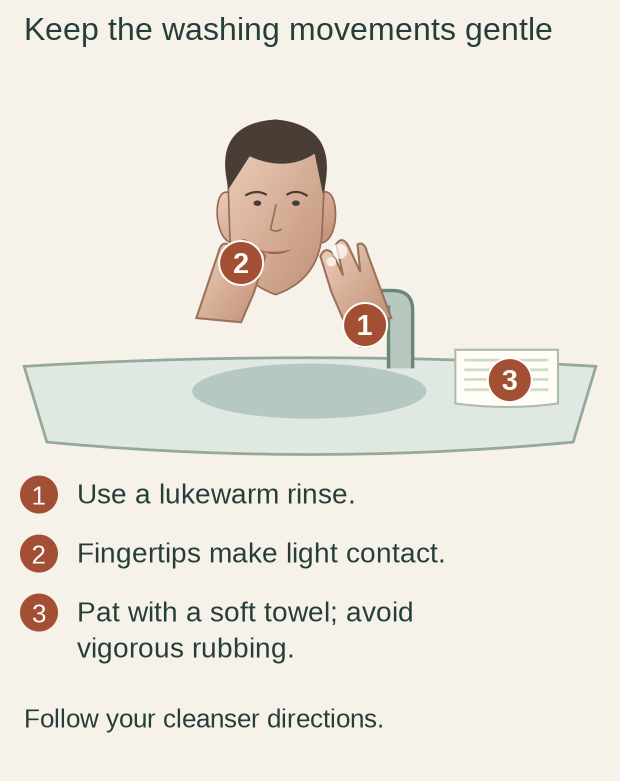
Don’t add a brush or rough cloth merely because your cleanser doesn’t feel dramatic. If you have a separate reason to use a tool, that deserves its own assessment rather than becoming an automatic extra step.
Give rinsing its own moment
Keep your movements deliberate as you rinse around the hairline, jaw, and areas where you applied cleanser. You aren’t trying to scrub away a slippery feeling with a towel before the rinse is finished.
Follow the package instructions for removal instead of inventing a fixed minute count. Different products have their own directions, and a blog’s timer shouldn’t replace them.
If you often forget whether you’ve rinsed a particular area, use a consistent path you can remember. For example, think forehead, cheeks, then jaw, without turning the sequence into a medical technique or a rule everyone must follow.
Once you’re done, pat with the towel instead of rubbing back and forth. Put the towel somewhere it can be handled according to your normal laundry routine rather than leaving it in a pile of wet products.
Fit cleansing around your real schedule
Consider when you actually need a wash instead of automatically adding one whenever you pass a sink. Your morning, evening, and exercise plans may overlap, and your routine should remain understandable.
For oily skin, the AAD advises cleansing up to twice daily and after sweating. More aggressive washing isn’t a shortcut to a better outcome.
Suppose you exercise shortly before your usual evening routine. Think through how those tasks fit together, following any professional instructions, instead of treating them as two unrelated opportunities to use every product.
A small gym bag setup can help if your main obstacle is forgetting what you need. Bring clearly identified products and keep directions available rather than relying on an unmarked travel bottle.
Read removal instructions when makeup is involved
If you wear makeup or a product with specific removal directions, check those instructions alongside your cleanser’s label. Don’t assume rubbing harder is the answer when the first attempt hasn’t done what you expected.
You may need to ask a manufacturer how its product is intended to be removed. A specific answer about the item you use is more helpful than a broad rule declaring that everyone must wash twice in a row.
Keep eye-area instructions separate and take them seriously. Your usual facial cleanser isn’t automatically suitable for every use near your eyes simply because it comes in a gentle-looking package.
When you compare removal options, consider the number of steps you can comfortably manage. You don’t need to buy an entire collection just to copy a routine designed for someone else’s products.
Notice when tightness happens
If your face feels tight after washing, record when you first notice it and what you used. Include the product, technique, and any other recent changes instead of immediately deciding that you need a stronger treatment.
Keep the observation concrete: “cheeks feel tight after evening wash” is enough to start. It doesn’t establish your skin type, diagnose a condition, or identify an ingredient.
Check whether your actual use matched the cleanser directions. If you added repeated washes, rough rubbing, or extra tools, those are relevant details to mention when you ask for advice.
Don’t run a series of back-to-back washing experiments to settle the question in one night. If discomfort persists or keeps returning, a qualified clinician can help assess what is happening.
Make a replacement decision carefully
If you decide to consider another cleanser, write down the practical problem first. You might want a product with clear directions, a dispenser you can manage, or a texture you prefer using.
Compare exact formulas and packages rather than treating all products from one brand as equivalent. A small label photograph can help you avoid accidentally buying a neighboring version when you reorder.
Keep any treatment instructions in view while you shop. A basic cosmetic guide can’t tell you how to replace a prescribed wash or how a new product fits a medical plan.
Plan for the rushed evening
If you often hurry through washing, put your basic supplies in the order you reach for them. A familiar arrangement can make the routine easier to complete without increasing the number of products or adding another timer.
You might keep the cleanser near the tap, the towel on an accessible hook, and your remaining routine in a separate area. That separation helps you finish rinsing before reaching for whatever comes next.
If you travel, photograph the labels before packing and use a bag that keeps the containers identifiable. A manageable routine should survive an ordinary trip without becoming a mystery collection of small bottles.
Build a routine you can repeat
At the end of the week, ask whether the setup made washing easier and whether you have unresolved discomfort. Those are more useful questions than whether your routine looks impressive enough for a bathroom-shelf photograph.
Remove organizational obstacles one at a time, such as a towel you can’t reach or a bottle you keep confusing with another. You can improve the routine without adding a new active ingredient.
Your finished plan can be simple: clearly identified cleanser, directions followed, gentle contact, careful rinsing, and a useful note if something feels wrong. The point is a manageable habit and a clear path to help when you need it.