Body oil and lotion can both belong in skin care, but they are not automatically interchangeable. If you want a straightforward starting point for dry-feeling skin, compare a complete moisturizer first and treat an extra oil as an optional preference rather than a missing requirement.
The useful question is what your current routine is failing to do. You might want a different finish, an easier application, or more comfort after washing, and each of those is more specific than deciding that all oils are better than all lotions.
Separate the formula from the name
A bottle called body oil may contain one oil or a mixture of oils, fragrance, and other ingredients. A lotion is typically a more fluid moisturizing formula, but you still need its ingredient list and directions to know what you are buying.
Do not confuse a body oil intended to remain on your skin with a bath oil, cleansing oil, or fragranced product meant for another purpose. Similar packaging can hide very different instructions.
You also should not assume an ingredient described as natural is automatically a good fit for you. Read the complete label, consider any known sensitivities, and leave a product out if its intended use does not match yours.
When a package promises glow, that may describe appearance rather than a measurable improvement in dryness. Decide whether you actually want that finish before treating it as a benefit.
Understand water retention without overcomplicating it
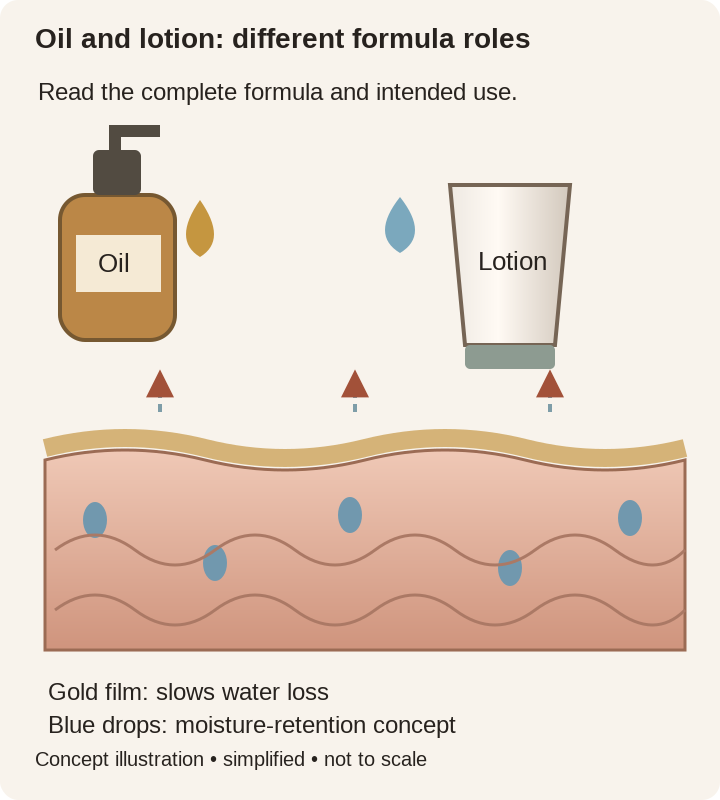
DermNet explains that moisturizers can use humectants to attract and retain water and occlusive ingredients to slow its evaporation. Oils can contribute to a surface film, but an oil-only product does not add a water phase just because it feels rich. (DermNet: Emollients and moisturisers)
A lotion may combine several of these functions in a single product, so comparing only one oil ingredient with one lotion ingredient misses the larger picture. Two products with very different textures can share some ingredients and still feel different.
You do not need to recreate a cosmetic laboratory in your bathroom. For ordinary use, it is enough to understand that an appealing sheen does not tell you exactly how your skin will feel later.
The diagram offers a concept view of those roles rather than a claim that one product creates a perfect seal. Real skin and real formulas are more complex than any single layer in an illustration.
Ask whether you need another product at all
If your usual lotion is comfortable after bathing and easy to apply, adding an oil is optional. A longer routine is not automatically a more effective or more enjoyable routine.
Imagine you already avoid moisturizing because you dislike waiting before getting dressed. Adding a second product might make that practical problem worse, even if the extra step looks attractive in a video.
Now imagine you enjoy a body oil’s finish for an occasional evening at home. You can acknowledge that preference without describing it as essential care or evidence that your lotion is inadequate.
Your starting point should be the simplest arrangement that meets your needs. Keep optional enjoyment separate from claims about repairing skin, treating a condition, or replacing professional advice.

Read the actual ingredient panel
FDA guidance says retail cosmetic ingredients generally appear in descending order of predominance. That helps you distinguish an oil-focused formula from a lotion with water near the beginning, although a list is not a complete performance report. (FDA: Cosmetic Ingredient Names)
You cannot calculate exact percentages from position alone or infer how a finished formula will behave just by counting familiar ingredients. Keep the bottle’s directions and intended body area beside the ingredient list when you compare options.
Write down fragrance information as its own item rather than assuming every plant oil is fragrance-free. A product can include both a bland base oil and added fragrance ingredients.
If an ingredient list is unavailable or unreadable, contact the manufacturer before using that uncertainty as an excuse to guess. Buying another formula with clear information is also a reasonable option.
Make the after-shower moment easier
The NHS recommends applying an emollient promptly after washing and gently patting your skin dry. In practice, you can prepare your usual moisturizer within reach before the shower so the next step does not require a search through drawers. (NHS: Emollients)
Apply the product according to its directions, keeping the floor and the container exterior clean. You should not have to stand on a wet tile surface while struggling with a slippery bottle.
If you want to try a separate oil, follow its own instructions rather than assuming every oil should be used at the same stage. You can ask a pharmacist how to fit a specific product around the moisturizer you already use.
Avoid premixing products in their containers or making a homemade lotion by adding water to an oil. A personal preference about texture is not a formula-preservation plan.
Compare ordinary finishes fairly
For a useful personal note, describe what you actually observe: spreads easily, transfers onto pajamas, feels sticky at the elbows, or makes the bottle difficult to hold. These are practical observations, not claims that you have tested clinical effectiveness.
Try to keep your clothing, shower habits, and other skin products reasonably consistent while answering your question. You do not need to alternate products constantly or cover different body areas just to produce a dramatic comparison.
If you dislike a texture, you can decide it is inconvenient without declaring that it harms everyone. If you enjoy a texture, you still cannot conclude that it will suit someone with a different history or skin condition.
A simple written sentence can prevent you from repeatedly buying the same unsuitable finish. For example, you might note that you want a pump lotion for mornings and have no need for another scented body product.
Remember the handling differences
An oil bottle with a dropper might be pleasant at a vanity and awkward when your hands are wet. A lotion pump might be easier beside your usual dressing spot but inconvenient in a small travel bag.
Consider how you will open, dispense, close, and store the product before choosing its size. A beautiful glass bottle is not necessarily the most manageable container in the place where you plan to use it.
Keep body products away from places where spills create a slipping hazard, especially at bath and shower edges. Clean the surface and your hands before handling items that require a secure grip.
The NHS also warns about the fire risk from fabrics carrying emollient residue. Keep affected clothing and bedding away from cigarettes, flames, and other ignition sources rather than assuming an oil-free label removes every concern.
Know when layering is the wrong experiment
Do not keep adding richer products over a new unexplained rash in the hope of finding the right combination. Stop a product that seems to worsen irritation and get advice when symptoms persist or are concerning.
If your skin is painful, cracked, bleeding, or repeatedly itchy, a cosmetic texture comparison cannot establish the cause. A clinician can assess whether you need a treatment plan rather than a different finish.
If you already use a prescribed cream or another medicated skin product, ask how any oil or lotion should fit around it. Do not dilute, premix, or change that treatment based on a general layering tip.
You can also decide that neither product on your shortlist is useful. That may be the right conclusion when both include an ingredient you avoid, neither explains its intended use clearly, or both create an impractical extra step.
Choose one next action
If you have no dependable body moisturizer, focus on finding a suitable, clearly labeled one that you will use consistently. If you already have one, first identify whether you want a different texture or simply a nicer optional ritual.
Bring that specific question to a pharmacist when you are unsure about the products in front of you. The goal is a routine you can manage comfortably, with clear directions and realistic expectations, rather than a rule that everyone must use both oil and lotion.
Photo Credits
- A complete lotion is one option; a separate body oil is an optional addition. Stock photograph by Yaroslav Shuraev; illustrative context.